Principles of T'ai Chi Ch'uan by Master Zhang Sanfeng
Ripening Peaches: Taoist Studies and Practices
How to Live a Good Life: Advice from Wise Persons
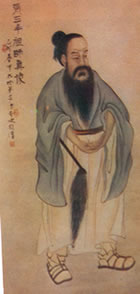
Taoist Grand Master Chang San-Feng
The Tao
of Tai-Chi Chuan: Way to Rejuvenation (1980) by Master Jou, Tsung Hwa
History, Folklore, and Legends
Taoist Master Chang San-Feng (Zhang Sanfeng)
One tradition claims that Master Chang San-Feng was born at midnight on April 9, 1247 CE, near Dragon-Tiger Mountain in Kiang-Hsi Province in the southeast of China. He is said to have been a government official in his youth, learned Shaolin martial arts while living in the Pao-Gi Mountains near Three Peaks (San Feng), and then lived for scores of years as a Taoist priest, healer, and sage at the Wudang Mountain Taoist Temples (Wutang, Wu Tang Shan). He is reported to have lived to be 200 years old (1247-1447 CE), but his death date is uncertain. He would have lived in the Sung, Yuan, and Ming Dynasties if these dates were accurate. (Jou, 1980)
Another tradition claims that there were two Master Chang
San-Feng Taoist priests and sages.
One
was born in the Sung dynasty (960-1279 CE), lived on Wudang Mountain as a
recluse, and
combined
the thirteen postures with other Taoist practices and arts to create a style of
internal martial
arts that became popular amongst the Taoists living and studying at Wudang
Mountain. The second Master Chang San-Feng (1279-1368), was a native of I-Chou in LiaoTung Province. His scholarly
name was Chuan Yee and Chun Shee. He also lived on Wudang Mountain and
was a highly regarded Taoist Master and scholar with many amazing magical,
divinatory and healing powers. He lived a very long life and was
very popular with the local people.
Master Chang is known by a variety of names: Chang San-Feng, Cheng San Feng, Chang Chun
Pao, Chang Sam Bong, Zhang Sanfeng, Chang Tung, Chang Chun-pao, Grandmaster
Chang, Chang the Immortal, Immortal Chang, Zhangsanfeng, Zhan Sa-Feng,
Zhan Jun-Bao, Yu-Xu Zi, Chuan Yee and Chun Shee. There may have been a number of male Taoist
priests and hermits who
chose to use the name Chang San-Feng.
Some legends have made Chang San Feng into a Xian (Hsien)
仙
仚
僊. A
Xian is a Taoist
term for an
enlightened person, an immortal, an alchemist, a wizard, a spirit, an inspired
sage, a person with super powers, a magician, or a transcendent being. A Xian 仙
is similar in function to a Rishi who is an inspired sage in the Indian
Vedas. I myself consider Chang San Feng, Master Chang, to be a Xian in my
poems.
"Xian are immune to heat and cold, untouched by the elements, and can fly, mounting upward with a fluttering motion. They dwell apart from the chaotic world of man, subsist on air and dew, are not anxious like ordinary people, and have the smooth skin and innocent faces of children. The transcendents live an effortless existence that is best described as spontaneous. They recall the ancient Indian ascetics and holy men known as rishi who possessed similar traits."
- Victor Mair, Wandering on the Way
The early legends about Master Chang San-Feng are linked with activities of Emperor
Chengzu
(1403-1424) who searched for Master Chang and other political refugees. By 1459,
Master Chang
had been declared an Immortal and, as with most saints, stories of his
miraculous
powers became part of the folklore in the Wudang Mountain area. There is a
fairly
long tradition amongst Wundang Mountain martial artists and Taoists that attributes the
development
of soft style martial arts to Chang San-Feng and his disciples
(Yeo, 2001; Wong Kiew Kit, 1996). In 1670,
Huang Zongxi wrote a book
called Epitaph for Wang Zhengnan in which Chang San-Feng was called the founder of internal martial arts practiced near Mount Wudang.
By the
1870's, Yang family Tai Chi Chuan teachers were claiming that Chang San-Feng was the originator of
Tai Chi Chuan. (Wong, 1997; Wile, 1996; Bing YeYoung, 2006.)
Wudang Mountain
(Wudangshan 武当山) has many Taoist temples, monasteries, and facilities.
It has been an renowned academic center since 700 CE. It has long been associated
with Taoist studies and practices, Taoist scriptures, traditional Chinese medicine, herbal
research, agricultural arts, meditation, unique exercises to increase
longevity, and internal martial arts. Zhang San Feng has been linked with most aspects of
this Wudang
culture.
More recently, some scholars and tai-chi historians have argued that Chang San-Feng
had
little or nothing to do with the founding of Tai Chi Chuan or internal martial
arts. They
contend that this aspect of the Master Chang legend was invented in the late
19th
century by Yang family stylists to give their art form deeper historical
roots. (Wile, 1996;
Tang Hao, History of Chinese Wushu, 1935; Henning, 1981; and Siaw-Voon Sim, 2002; Bing YeYoung, 2006;
John Bracy, 2008.)
These authors
contend that the Tai Chi Chuan systems
(i.e., forms, push hands, sword/staff, chi
kung exercises,
and Taijiquan principles) as
we
know them today (e.g., Chen, Yang, Wu, Hao, Sun), were all created as successive
variants to the system developed by the military leader and martial artist Chen Wangting
(1600-1680)of Chenjiagou Village in Henan Province.
My own view is that the Taoist Master Zhang San Feng was a
real person, living around 1200 CE. He traveled extensively, and like any
sensible long distance walker in those days, was skilled in martial arts for
self defense (probably including using the sword and/or staff). He enjoyed
learning from different Taoist, Confucian and Buddhist teachers. He likely stayed for some
length of time at the Shaolin Temple and at Taoist centers on Mt. Hua and
finally at Mt. Wudang. He was very reclusive, and disregarded social
proprieties. He was a highly respected Taoist master of
internal energy arts,
a defensive and "internal" style of martial arts, alchemy, mysticism, and philosophy. His deep knowledge,
high moral character, writings, and high level of skills attracted many Taoist
followers who continued his mind-body Taoist practices, studied writings attributed to him, and
told and retold stories (many apocryphal) about Master Zhang over the past 900
years.
People in China, Tibet, and India have for millennia used exercises to improve
health,
cure disease, restore vitality, and increase lifespan. Gentle stretching,
breathing
methods, herbal remedies, and use of postures for exercise can be traced
back over 4,000 years. Martial arts training methods, of course, are of similar
antiquity.
Good old Master Chang, like the Bodhidharma of Shaolin fame, are just reference
points for the imagination steeped in these many centuries of martial
arts, health exercises, and the history of Taoism, Buddhism, and Hinduism.
At another level, Master Chang, Han
Shan, and the Bodhidharma are also examples,
archetypes if you will, of the crazy saint, wise fool, sage, healer, shaman, and wandering
recluse
that contrasts so markedly with the ordinary family-society lifestyles of the vast
majority in any culture or civilization. The Buddha himself, after
military training
in his youth, left his family
life to
wander and live the life of a solitary ascetic and mystic for a decade.
So, we
sometimes
look to these fellows, real and imaginary, and ask them "So, old man, what
have
you learned that can help us?" We listen to their advice, and
sometimes follow their recommendations. Sometimes we laugh at them and bang their
copper hat. In moments of whimsy, religious fervor or
desperation, we give some of them, like Chang San-Feng or Chang Po-Tuan, magical
and marvelous powers - to disappear and reappear at will, powers to cause rain to fall,
powers to prevent disaster, powers to chase away malevolent spirits, shamanistic skills, techniques for defeating our enemies, methods
for calming our troubled souls, and amazing skills at divination. Most important, and what intrigues most
folks, is that these hermit seers might hold the secrets for living over 150 years in
good health, or rising from the dead, or pointing to the Way for us to attain eternal life as an Immortal - a Chen Jen: Realized Being.
"Breathing Out -
Touching the Root of Heaven,
One's heart opens;
The Dragon slips by like water..
Breathing In -
Standing on the Root of Earth,
One's heart is still and deep;
The Tiger's claw cannot be moved.
As you go on breathing in this frame of mind, with these associations,
alternating
between movement and stillness, it is important that the focus of your mind does
not shift. Let the true breath come and go, a subtle continuum on the
brink
of existence. Tune the breathing until you get breath without breathing;
become
one with it, and then the spirit can be solidified and the elixir can be
made."
- Chang San-Feng, Commentary on Ancestor Lu's Hundred-Character
Tablet
Translated by Thomas Cleary, Vitality,
Energy, Spirit: A Taoist Sourcebook, 1991, p. 187.
Poetic interpretation by Mike Garofalo of expository text of
Chang San-Feng.
Return to the Main Index for this Webpage

Bibliography and Links
Master Chang San-Feng
Above the Fog. Poems by Michael P. Garofalo
Advanced Yang Style Tai Chi Chuan. Volume One: Tai Chi Theory and Tai Chi
Jing. By Dr. Yang, Jwing-Ming. Boston, Massachusetts, Yang's Martial Arts
Academy,
YMAA, 1986. Glossary, 276 pages. ISBN: Unknown. The
"Tai Chi Chuan Treatise"
by Chang San-Feng is shown in Chinese, translated into English, and
commented by Dr. Yang on pages 213- 216.
Ancestor Lu's Hundred-Character Tablet
Commentary by Chang San-Feng.
Chang
San-Feng and Wudang Mountain
Chang San-Feng: His
Life and Deeds. By Jack McGann and Christopher Dow. An
apocryphal biography of the legendary founder of Tai Chi Chuan. An
interesting short biography with some new stories about Master Zhang.
Chang San-Feng, Taoist
Master. Brief biography, links, bibliography, quotations, and a study
of the "Treatise on Tai Chi Chuan". Compiled by Michael P.
Garofalo. Includes poems and commentary
by Mike Garofalo. Red Bluff, California, Green Way Research.
Chen
Style Taijiquan: The Source of Taiji Boxing. By Davidine Siaw-Voon Sim
and
David Gaffney. Berkeley, CA, North Atlantic Books, 2002. Index,
charts, 224 pages.
ISBN: 1556433778. Provides an excellent introduction to
Chen style Taijiquan
history and legends, outlines the major forms, discusses the philosophy and foundations of the art.
Cloud Hands: Taijiquan
and Qigong Website
Cold Mountain Buddhas (Han
Shan)
The
Complete Book of Tai Chi Chuan: A Comprehensive Guide to the Principles
and Practice. By Wong Kiew Kit. Shaftesbury, Dorset, Element, 1996.
Index,
bibliography, 316 pages. ISBN: 1852307927. Zhang San Feng, pp.
18-22.
Commentary on Ancestor Lu's Hundred-Character Table by Chang,
San-Feng
Cuttings: Haiku and
Short Poems
|
Tao Te Ching by Lao Tzu
For each of
the 81 Chapters: Daodejing 81 Website |
|
||||||||||||||||||||||||||||||||||||||||||||||||||||||||||||||||||||||||||||||||||||||||||||||||||||
Dao House: Of Discourses and Dreams "A compendium of links to great online Daoist (Taoist) resources." An excellent selection of fine links with informative and fair annotations; all presented in an attractive and easy to read format. The in-depth and creative collection of links are arranged by 18 topics.
The
Essence of T'ai Chi Ch'uan: The Literary Tradition. Translated and
edited by
Benjamin Pang Jeng Lo; Martin Inn, Robert Amacker, and Susan Foe.
Berkeley,
California, North Atlantic Books, 1979, 1985. 100 pages. ISBN:
0913028630. The "T'ai Chi Ch'uan Ching" by Chang San-feng is translated on pages
17-27.
Evolution of
Taijiquan from Shaolinquan. Written by Sifu Zhang Wuji, Instructor,
Shaolin Wahnam, Singapore.
The Founder
of Wudang Tai Chi Zhuan - Zhang San-Feng
Heavenly Pattern of Boxing. Article by Wong Yuen-Ming.
"Please check the new Journal of
Cinese Martial Studies out of Hong Kong. The editor Wong Yuen-Ming has
written a very interesting paper on the "Heavenly Pattern of Boxing", concerning
non-governmental writings on Zhang Sanfeng. They have a website to find sources.
(Email from Hermann, 8/11/2012)."
The
History and Legend of Tai Chi Chuan. By Dick Watson
History of Yang Style Tai Chi
Chuan. By Craig Rice.
The Immortal Zhang San Feng.
Published by PureInsight.org. This is just an unauthorized and
unattributed copy of an older copy of this webpage by Mike Garofalo.
Index to a Short
Review of the Art of T'ai Chi Ch'uan. By R. W. Watson.
Investigations into the Authenticity of the Chang San-Feng Ch'uan-Chi.
The Complete Works of Chang San-Feng. Faculty of Asian Studies Monographs,
1997. Australian National University. Authored by Wong Shiu Hon.
Ignorance, Legend and Tai
Chi Chuan. By Stanley Hemming. Journal of the Chen Style Taijiquan Research Association of Hawaii, Vol. 2, No. 3, pp. 1-7.
23Kb.
Let a Hundred Flowers
Bloom. By Jay Dungar.
Literati
Tradition: The Origins of Taiji. The Origins of Tai Chi - The Chang
San Feng Camp.
By Bing YeYoung. A well researched article. Includes bibliographical
references.
Lost
T'ai-chi Classics from the Late Ch'ing Dynasty. By Douglas Wile.
State University of
New York Press, 1996. ISBN: 079142653X. Index, charts, bibliography,
233 pages. The
most detailed and scholarly account of Tai Chi Chuan classics available.
Analysis and
translation of many new texts. Chang San-feng texts are found on pp.
86-89, and discussion
about the historicity of Chang San-feng on pp. 108-111.
Master Chang San-Feng
Legends and Lore, Quotations, Links, Poems.
Meetings with Master Chang San Feng - Poetic Reflections
Mount
Wudang Abode of the Immortals and a Martial Monk
Mount Wudang and
Wudang Kung Fu
The Mythical
Life of Chang San Feng. By John Hancock. 36K. An
excellent informative article.
"A New Look at T'a Chi Origins." By Alex Yeo. T'ai Chi,
Volume 25, No. 4, pp.21- 27,
August, 2001.
One Old Druid's Final
Journey: Notebooks of the Librarian of Gushen Grove
The Origins
of Tai Chi - The Chang San Feng Camp. Literati Tradition: The Origins
of Taiji.
By Bing YeYoung. A well researched article. Includes bibliographical
references. 36Kb.
Return to the Main Index for this Webpage
Plexus: History and Myth Interesting collection of facts and observations about Mt. Hua in China.
Portraits of Chang San Feng: First,
Second -
color, Third,
Fourth, Fifth
Principles of Taijiquan by Chang San-Feng
Refining the
Elixir: The Internal Alchemy Teachings of Taoist Immortal Zhang Sanfeng.
Translation and commentary by Stuart Alve Olson. Phoenix, Valley Spirit
Press, 2013.
"Refining the Elixir is one of the clearest and most in-depth analyses on
Internal Alchemy (Neidan) in English. Aside from the excellent translation work,
Stuart Alve Olson provides extensive introductory sections and commentaries on
the texts—a wonderful guide for practicing and learning the meditation art and
science of Internal Alchemy. Stuart addresses the mystical terminology of
Internal Alchemy by explaining it in understandable, detailed, and practical
terms. Anyone, no matter the tradition of meditation followed, will find this
book inspiring and enlightening. Four important works by Zhang Sanfeng
(Three Peaks Zhang) are provided, along with commentaries: The Great Process for
Refining the Elixir Treatise, Verses on Seated Meditation, The Sleeping
Immortal, Zhang Sanfeng’s Commentary on Lu Zi’s One Hundred Word Discourse.
These four works of Zhang Sanfeng outline clear perspectives on the Taoist
practice of Internal Alchemy, a unique and effective system designed for the
development of health, longevity, and immortality. Zhang Sanfeng, a Taoist
priest of the twelfth century, is not only credited with the creation of Tai Ji
Quan, but with some of the greatest Internal Alchemy texts. He reportedly lived
170 years, from the late Song dynasty through the Yuan and into the early Ming
dynasty. Zhang’s life exemplified the Chinese ideal of a true “cloud wandering”
immortal. His internal alchemy and meditation texts reveal not only his deep
wisdom, but his great influence on Taoism and the teachings leading to
immortality."
Ripening Peaches: Taoist
Studies and Practices
The Rootless Tree. Attributed to Chang San-Feng.
The
Shambhala Guide to Taoism. By Eva Wong. Boston,
Shambhala, 1997. Index,
appendices, 268 pages. ISBN: 1570621691.
Song of Silent Sitting. Attributed to Taoist
Master Chang San-Feng. Taken from the book "The Secret of Training the Internal Elixir in the Tai Chi
Art."
Sword (Jian):
Links, bibliography, quotes, notes.
T'ai-Chi. By Cheng Man-ch’ing and
Robert W. Smith. 1966.
T'ai Chi Ch'uan
Ching. By Chang San Feng. Researched by Lee N. Scheele.
T'ai Chi Ch'uan Classics
Researched by Lee N. Scheele.
T’ai Chi Ch’uan For Health and
Self-Defense. Philosophy and Practice.
By Master T. T. Liang. Edited and with a foreword by Paul B. Gallagher.
Revised, expanded edition, 1977. New York, Vintage Books, 1974, 1977.
133 pages. ISBN: 0394724615. Includes a translation and commentary
on the Treatise, pp. 17-22.
Tai Chi Chuan: History and
Origins
Tai-Chi Chuan in Theory and Practice. By Kuo
Lien-Ying. 1999.
T'ai
Chi Classics. By Waysun Liao. New translations of three
essential texts of T'ai Chi Ch'uan with commentary and practical instruction by Waysun Liao.
Illustrated by the author. Boston, Shambhala, 1977, 1990. 210 pages. ISBN: 087773531X. A
translation and commentary on the "Treatise of Master Chang San-Feng" is found on
pages 87-95.
The
Taijiquan Classics: An Annotated Translation. By Barbara Davis.
Includes a commentary by Chen Wei-ming.
San Franscisco, North Atlantic Books, 2004. Index,
notes, bibliography, 212 pages. ISBN:
1556434316.
Taijiquan Classics
Compilation and Comparison. By Almanzo "Lo Ma"
Lamoureux and others. Includes good notes on other translations of Master Chang's Treatise. Sample.
Taijiquan History and Development.
By Peter Lim Tian Tek. Outstanding collection of
webpages.
Taijiquan Jing by Zhang Sanfeng
Tai Ji Quan Treatise: Attributed to the Song Dynasty Daoist Priest Zhang
Sanfeng. By Stuart Alve Olson. CreateSpace Independent Publishing
Platform, 2011. Daoist Immortal Three Peaks Zhang Series. 120 pages.
ISBN: 978-1490345529.
Taijiquan Treatise of Zhang San Feng. Website of Sifu Wong Kiew Kit.
Taoism, Paganism, Nature
Mysticism, Plant Lore, and Magic
Tao of
Health, Longevity, and Immortality: The Teachings of Immortals Chung and Lu.
Translated
with commentary by Eva Wong. Boston, Shambhala Publications, 2000.
144 pages. ISBN: 1570627258.
The Tao
of Tai-Chi Chuan: Way to Rejuvenation. By Jou, Tsung
Hwa. Edited by Shoshana
Shapiro. Warwick, New York, Tai Chi Foundation, 1980. 263
pages. First Edition. ISBN: 0804813574. An excellent comprehensive textbook. A Third Edition is now
available. Information on Master Chang on pages 2-10. Mr. Jou has provided a
translation and commentary on the "Tai-Chi Chuan Lun" or "The Theory of Tai-Chi
Chuan" by Chang
San-Feng on pages 175- 180.
Taoist
Master Zhang San-Feng
Legends and Lore, Quotations, Links, Poems.
Taoist
Meditation: Methods for Cultivating a Healthy Mind and Body.
Translated by Thomas Cleary.
Boston, Shambhala Publications, 2000. 130 pages. ISBN: 1570625670.
Includes Master
Chang's "Taji Alchemy Secrets."
Tao Te Ching (Daodejing) by Lao Tzu (Laozi) Compilation and
indexing by Mike Garofalo.
Treatise on T'ai Chi Ch'uan by Zhang San-feng.
Treatise on Tai Chi.
Translated by Stuart Alve Olsen and found in "Tai Chi Chuan According to the I Ching."
Return to the Main Index for this Webpage
Valley Spirit Taijiquan Red Bluff, California. Instructor: Michael P. Garofalo.
Vitality,
Energy, Spirit: A Taoist Sourcebook. Translated and edited
by Thomas Cleary. Boston,
Shambhala, 1991. 281 pages. ISBN: 0877735190. Translations
of writing
by Chang San-Feng on pages 183 - 216.
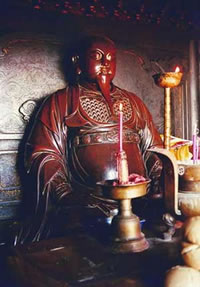
Wood Carving of Chang San-Feng
from Tao Arts
Writings on the
Tao by Master Chang Sanfeng
Wudang Inner Boxing and Wudang Taoist Zhang San-feng
Wudang Qigong: Bibliography,
Links, Resources, Lessons, Quotes, Notes
Wudang Taijiquan: Bibliography, Links, Resources,
Quotes, Notes
Wudang Sword Forms: Bibliography,
Links, Resources, Quotes, Notes, Forms
Wudang Taoist
Inner Alchemy Practice
Zhang San-Feng
Legends and Lore, Quotations, Links, Poems.
Zhang, San-Feng and the Ancient Origins
of Taijiquan, Part I. By David Silver. A very interesting and
informative article.
Zhang, San-Feng
and the Ancient Origins of Taijiquan, Part II. By David Silver.
Zhang San Feng Discussion Board
The Zhang San-Feng
Myth by John Bracy
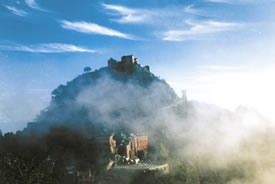
Wu Tang Mountain Area
Return to the Main Index for this Webpage
Quotations
Master Zhang San-Feng
"Much of the written material about Zhang Sanfeng is mythical,
contradictory, or otherwise suspect. For instance, he is reported to have been born in AD 960, AD 1247, and again in AD 1279. He
is described as being seven-feet tall, with the bones of a crane and the posture of a pine tree, having whiskers shaped
like a spear, and being able to cover 1000 Li in a day."
- Wikipedia
"Aside from being a wise sage, Master Chang
is also known as the Father of the 'Grand Supreme Fist', Tai Chi Chuan. Chang discovered that most Wu Kuen, that is to say martial forms, were
too vigorous and relied too heavily upon the physical strength. It is told that Master Chang, ever observant of Nature,
once witnessed a combat between a snake and a bird. The noise of this contest had disturbed the Master's
devotions, and venturing forth from his modest hut, he witnessed the bird to attack the snake. At each pass, the bird fiercely
pecked and clawed at the snake, however,
the reptile through suppleness and coiling of his form, was able to avoid the
attacks and launch strikes of his own. The bird in his turn circled and used his wings beat the
snake aside when he
struck. Master Chang contemplated upon this experience. That night, as the Master slept, Yu Huang,
the 'Glorious Jade Emperor', visited Chang in his dreams and
instructed him, teaching him the secrets of the Tao that the bird and
the snake innately knew. The next day, Chang sprang up from his sleep wide awake and inspired by his
Celestial Visitor, and immediately set about the creation of a new Martial Art form that relied upon Internal Power, or Chi, at
its root. This art held as its foundation the Truth that 'yielding overcomes aggression' and 'softness overpowers
hardness'. In honor of his divine influences, Chang called his art Tai Chi Chuan, the 'Grand Supreme Fist'. For
this, Master Chang is know as the progenitor of the Wu Tang Ru (schools), so named because they come from Wu Tang Shan
(mountain). These are the Internal Arts, which are juxtaposed to the External Arts, such as Shao Lin Chuan, which relies upon the physical mastery of
the body and development of great strengths.
- John Hancock, The
Mythical Life of Chang San Feng.
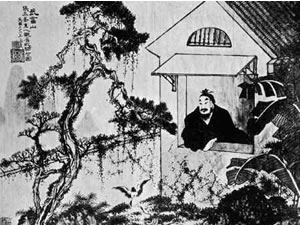
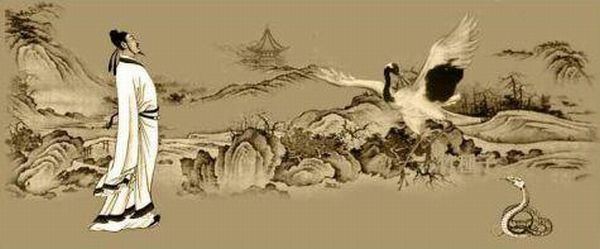
Master Chang San-Feng Watches the Fight Between the Bird and Snake
"Most people recognize Chang San Feng as the
founder of T'ai Chi Ch'uan. The Chang San Feng legend can be viewed as having three phases: phase I (prior to 1669) merely claims that Chang was a
Taoist immortal; phase II (after 1669) claims that he founded the "internal" school of boxing; and phase III
(post 1900) claims that Taijiquan originated with Chang. The Chang San Feng legend evolved during the Ming period (1368-1644),
based on the close association of early Ming rulers with Taoism and Taoist priests, whose prophecies had supported
the founder of the dynasty. Little is known about Zhang except that he is described as an eccentric, itinerant hermit
with magical powers, who died once, but came back to life, and whose life, based on varying accounts, spanned a
period of over 300 years. According to
legend, Chang San Feng created a new set of exercises now known as taijiquan in
the Wudang Mountains."
- Ottawa Chinese Martial Arts, Tai
Chi History
"When the winter was really cold and the track outside the temple, where
he practiced was covered with snow, Chang liked to go out and enjoy the snow-covered landscape. Where he had walked there were no footsteps - like no one had walked there. ... It’s also said, that when he was meditating at night, his cultivated energy - the so-called Chi or Jing - would make his coat flap, and the walls around him would shake. This phenomenon
indicates, that his energy had reached its peak. He had obtained the state where his Chi had been transformed into Shen or
Spirit."
- Bjřrn Darboe Nissen, Tai
Chi Chuan and the Human Being
"Some have raised the question of Chang San Feng's existence as there is
much legendary material about him. He is recorded by reliable historical documents such as the
'Ming History' and 'The
Ningpo Chronicles' which have no relation to martial arts literature as having
existed and to have created Wudang Internal Boxing arts. This is in line with the
beliefs held at the Wudang Temple itself and one can find much old material pertaining to Chang San
Feng there. According to the available material, Chang lived at the end of the Yuan
Dynasty (1279-1368) and at the beginning of the Ming Dynasty (1368-1644)."
- Peter Lim Tian Tek, The
Origins of Tai Chi Chuan
"The legend of Zhang Sanfeng. therefore, evolved in three stages: prior to
1670 , he was known simply as a Daoist immortal; after 1670 he was credited as the creator of
the "internal" martial arts; and after 1900, as the founder of Taijiquan. Emperor Chengzu (1403-1424) contributed greatly to the legend. Zhang was canonized in
1459. The earliest extant reference to Zhang as a master in martial arts appeared in1670
in the Epitaph for Wang Zhengnan, composed by Huang Zongxi, when Chinese
martial art was categorized into an "external" school of Shaolin originated by
the Buddhist monk Damo, and an "internal" school initiated by Daoist immortal Zhang
Sanfeng of Mount Wudang. Li I-yu in his Brief Preface to Taijiquan (1867)
referred to Zhang as the originator of Taijiquan."
- Chen
Style Taijiquan: The Source of Taiji Boxing. By Davidine Siaw-Voon Sim
and
David Gaffney, p. 28.
"Examples of myths believed by large
numbers to be true includes the story of a man named Zhang San-Feng as the
originator of Tai Chi Chuan and the relationship of internal martial arts to the
Wu Tang monastery. In the case of Zhang San-Feng (also written Chang San-Fang),
although often referred to as the founder of Tai Chi, historical evidence does
not support this assertion. According to martial art historian Douglas Wile,
Zhang was first suggested as the originator of Tai Chi in the middle 1800s. The
legend that developed around the Zhang myth is a good entry point for our
discussion of legend mistakenly represented as factual. According to story,
Zhang is believed to have developed a fighting style based on his observations
of, or dreaming about, a fight between a bird of prey and a snake. However,
historians have been unable to ascertain if Zhang, supposedly an alchemist who
lived (depending on the source) in either the twelfth, thirteenth or fourteenth
centuries, ever truly existed. In contrast, historical evidence supports the
founding of Tai Chi Chuan as traceable to the Chen Family Village (or possibly
the Yang Family)-about three hundred years ago.
In much the same way as the Zhang legend, in contrast to what
Chinese historians tell us, the legend of the Wu Tang monastery long ago
captured the imagination of the writers of Chinese comic books and filmmakers as
the place where the internal martial arts were founded and popularly believed to
represent a sort of yin -yang counterinfluence to the famous Shaolin monastery.
An even bigger mess unfolds when one discusses "secret arts" said to derive from
the supposed merging of Buddhist and Taoist "internal energy" practices.
Although the popular fable holds that secret methods were exchanged between
Buddhist monks and Taoist recluses, it is problematic that first, aside from
extremely rare incidences, such as possibly Chan (Zen) Buddhism, no evidence
supports the merging of Buddhism and Taoism into a secret chi energy based cult,
and second, with the exception of Indian and Tibetan tantric practices (see
chapter six, section three), there are no secret Buddhist energetic practices
and no evidence supporting the pop belief that monks secretly practiced and
merged separate "energetic" traditions."
- The Zhang
San-Feng Myth by John Bracy
"Damo wrote the two classics on changing the tendons and washing the
marrow. He taught
men to practice this in order to strengthen their bodies. Then we come to
Yue Wumu Wang
of the Song Dynasty. He added to the discovery of two classics of body
nurturing. He created Xingyi Quan and directed its usage. The principles of Bagua Quan
are also contained
within. This is the origin of the inner family fist arts. During the
reign of Yuan Shunti, Zhang Sanfeng practiced Daoism on Wudang Mountain. He met a teacher of internal
alchemy.
Both of them practiced martial arts that used Post-natal strength. The
function was more than
proper. However, their arts did not harmonize with Qi inside. They
had the potential to cause
injury to the Dan and injure the original Qi. Therefore, they incorporated
the nurturing methods
of the first two classics and use the whole character of the form of the Taiji
circle. They included
the principles of the Ho Diagram and the Luo Book. Pre and Post many
changes. Flowing with natural principles. Created the Taiji Martial Arts. It explains
the mysteries of nurturing
the body. This martial art borrows the form of the Post-natal. It
does not use Post-natal
strength. In moving and stillness, it pure uses natural. It does not
esteem animal vitality.
The idea is for the Qi to transform into spirit."
- Sun Lu Tang, 1919, Study of Taiji Boxing
Translated by Joseph Crandall, 2000, p. 6
"The 'Cave of the Immortal Chang" at West Pass is
traditionally regarded as the site
where Chang San-feng realized immortality. The Fu-kou Gazetteer
says that the people of Fu-kou believe Chang San-feng left his body in the T'ai-chi Temple on
the
Wu-tang Mountains. An image of him may still be seen there. He wore
a copper
cymbal as a straw hat, which he allowed the people of the Fu-kou to strike
without
becoming angry, for he was very good-natured. The people of Wu-yang
also believe that Chang San-feng was a native of Wu-yang and that they have the
exclusive privilege of striking his hat."
- Lost
T'ai-chi Classics from the Late Ch'ing Dynasty, translated by Douglas Wile,
p. 110.
"In 1990 the magazine 'The Soul of Wushu' published a series of
articles entitled 'The Original Taijiquan'. One contribution came from the chief Taoist monk of
the Temple Baijun (White Cloud) in Beijing. 'An Shenyuan'. When questioned by reporters,
remarked that, "In the school of Taoism, apart from Zhang Sanfeng, there were
many other talented people who have contributed much to the formulation and development to
Taijiquan."
- R. V. Watson, Index
to a Short Review of the Art of Taijiquan
"Another Zhang San Feng was a native of I-Chou in LiaoTung Province. His
scholar name was Chuan Yee and Chun Shee. He lived in Yuan dynasty (1279-1368).
The Chinese old book Ming History bearing records available in the monastery
on Wudang Mountain does indeed mention him. Descriptions picture him as being seven feet tall, with the bones of a crane and the posture of a pine tree,
whiskers shaped like a spear, winter and summer wearing the same bamboo hat,
carrying a horsehair duster and being able to cover 1000 Li in a day, sometimes
eating 50 Kg food in one meal, sometimes keeping fasting as long as several
months, possessing amazing memory as to recite a scripture fluently after reading it
just one time. The early legends about Zhang San-Feng are linked with
activities of Emperor Chengzu (1403-1424) who searched for Zhang for many years
without results. By 1459, Zhang had been declared an Immortal and, as with most
saints, stories of his miraculous powers became part of the folklore in the Wudang Mountain area. There is a fairly long tradition amongst Wundang Mountain martial artists and Taoists that attributes the development of soft style martial arts to Chang San-Feng and his disciples. In 1670, Huang Zongxi wrote a book called Epitaph for Wang Zhengnan in which Zhang
San-Feng was called the founder of internal martial arts practiced near Mount Wudang.
- Wudang
Taoist Inner Alchemy Practice
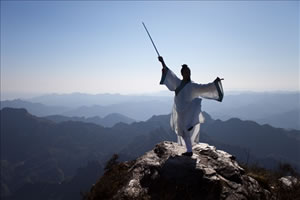
"T'ai Chi Ch'üan's theories and practice are therefore believed by some
schools to have been formulated by the Taoist monk Chang San-feng in the 12th century, a time frame
fitting well with when the principles of the Neo-Confucian school were making themselves felt
in Chinese intellectual life. Therefore the didactic story is told that Chang San-feng as a
young man studied Tao Yin breathing exercises from his Taoist teachers and martial
arts at the Buddhist Shaolin monastery, eventually combining the martial forms and breathing
exercises to formulate the soft or internal principles we associate with T'ai Chi Ch'üan and related
martial arts. Its subsequent fame attributed to his teaching, Wu Tang monastery was known
thereafter as an important martial center for many centuries, its many styles of internal kung fu
preserved and refined at various Taoist temples."
- Hans
Wolfgang
"The art Zhang Sanfeng evolved was
certainly better and more profound than the one he had learnt. I believe that
Zhang Sanfeng himself did not give different names to the art before and the art
after his evolution. He just called them, or it as to him they were the same
art, “Shaolinquan”.
Instead of practicing martial art forms (gongfu), energy
exercises (qigong) and meditation (chan) separately, Zhang Sanfeng integrated
all these three aspects into one unity. This was a tremendous contribution to
the whole of kungfu history, for which he is rightly honored as the First
Patriarch of the Internal Arts. We in Shaolin Wahnam are particularly grateful
to this great master for this development.
Later on, to differentiate the distinct type of Shaolinquan
practiced at the Wudang Mountain where Zhang Sanfeng evolved it from the
original version at the Shaolin Temple at Henan, people called it “Wudang
Shaolinquan. Over the years, this term was shortened to just Wudangquan. Much
later when the great master Chen Wang Ting employed yin-yang principles from the
Taiji concept to explain its principles, people called it “Taijiquan”."
-
Evolution of Taijiquan from Shaolinquan. Written by Sifu Zhang Wuji,
Instructor, Shaolin Wahnam, Singapore.
"Joseph Lee in 'The History of Chinese Science and
Technology' remarked, "The name of Zhang Sanfeng is now firmly related with Taijiquan, a major
school of Chinese Wushu". He goes on to say, "if one really wants to track
down the roots of Taijiquan one cannot fail to value Zhang Sanfengs theistic thoughts on
Taoism"
In 'The Origins of Wudang Taiji' Du Yuwan says, "Taijiquan is
generally said to be passed down from Zhang Sanfeng, but when we get down to the roots we find its beginnings further back in history".
- The
History and Legend of Tai Chi Chuan
"Chang San-feng is one of the greatest figures of later Taoist history and
legend, believed to be master of all the arts and arcana of the Way. He is
particularly famous
as the alleged originator of the popular exercise system know as
t'ai-chi-ch'üan
(taijiquan). Like Ancestor Lü, Chang San-feng is also believed to have
attained
immortality in more than a purely spiritual sense, and to have reappeared in the
world
after his supposed physical death. The works attributed to him, again like
those of Ancestor Lü, are also evidently mixed with later additions and in some cases
may be viewed as generic products of a school rather than works of an individual
author. The
Chang San-feng literature shows an amalgamation of Southern and Northern Schools
of Complete Reality Taoism, as well as traces of older Taoist sects
practicing magical arts."
- Thomas Cleary, Vitality, Energy, Spirit: A Taoist Sourcebook,
1991, p. 183
|
Tao Te
Ching |
|||||||||
| 1 | 2 | 3 | 4 | 5 | 6 | 7 | 8 | 9 | 10 |
| 11 | 12 | 13 | 14 | 15 | 16 | 17 | 18 | 19 | 20 |
| 21 | 22 | 23 | 24 | 25 | 26 | 27 | 28 | 29 | 30 |
| 31 | 32 | 33 | 34 | 35 | 36 | 37 | 38 | 39 | 40 |
| 41 | 42 | 43 | 44 | 45 | 46 | 47 | 48 | 49 | 50 |
| 51 | 52 | 53 | 54 | 55 | 56 | 57 | 58 | 59 | 60 |
| 61 | 62 | 63 | 64 | 65 | 66 | 67 | 68 | 69 | 70 |
| 71 | 72 | 73 | 74 | 75 | 76 | 77 | 78 | 79 | 80 |
| 81 | |||||||||
"Zhang Sanfeng was a semi-mythical Chinese Taoist priest who is believed by some to have achieved immortality, said variously to date from either the late Song dynasty, Yuan dynasty or Ming dynasty. His name was allegedly 張君寶 before he became a Taoist.
His Taoist name in Traditional Chinese characters is 張三丰, or 張三豐. Both are Zhāng Sānfēng in pinyin and Chang1 San1-feng1 in Wade-Giles.
Much of the written material about him is mythical, contradictory, or otherwise suspect. For instance, he is reported by different people to have been born either in 960, 1247, or in 1279. He is described as being seven-feet tall, with the bones of a crane and the posture of a pine tree, having whiskers shaped like a spear, and being able to cover 1000 li in a day (roughly 580 km or 350 miles). He is reputed to have worn a straw hat, but one village reports that the hat was actually a cymbal, which only residents of the village (famous for manufacturing cymbals) had permission to sound upon meeting him.
Another tradition associated with the name has him an expert in the White Crane and Snake styles of Chinese martial arts as well as in the use of the Chinese straight sword or jian. According to relatively recent (19th century) documents preserved in the Yang and Wu families, the name of his Taoist teacher was Hsü Hsüan-p'ing, said to be a Tang dynasty poet.
Many today consider Zhang Sanfeng, if not to have been a verifiable
historical figure, to be a legendary culture
hero of sorts, credited as having originated the concepts of nei
chia; soft, internal martial
arts, specifically T'ai
Chi Ch'uan, as a result of a Neo-Confucian
syncretism of Chan Buddhist
Shaolin
Ch'uan with his mastery of Taoist Tao
Yin (qigong) principles. He is also associated in legend with the Taoist monasteries
at Wudangshan
in Hubei
province.
Some sources record two Chinese emperors sending missions to Zhang Sanfeng to ask for his advice, although neither mission is reported to have found him.
Owing to his mythical appearance, his name frequently appeared in Chinese novels and wuxia films of swordsmen as a spiritual teacher and master of martial arts.
Today, Chinese readers are most acquainted with Jin Yong's version of Zhang Sanfeng, thanks to the popularity of his wuxia novels. In his book The Heavenly Sword and the Dragon Saber, Zhang Sanfeng was a former Shaolin disciple in the late Song Dynasty, and born on May 15, 1247 (Day 9 of month 4 in Chinese calendar). He left Shaolin Temple to establish the Taoist monasteries in Wudangshan. In the book he had seven disciples, and was alive until the late Yuan Dynasty.
The T'ai Chi Ch'uan families who ascribe the foundation of their art to Zhang traditionally celebrate his birth date as the 9th day of the 3rd Chinese lunar month."
Wikipedia - Free Online Encyclopedia (Dynamic - Content Changes)
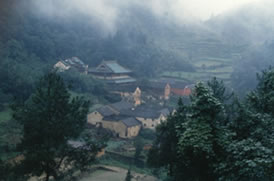
Wu Tang Mountain (Wudangshan)
Taoist Temple
"The peerless master moves with his group from place to place in the
mountains. His small band contains two highly advanced American disciples. After Babaji has
been in one locality for some time he says, 'Dera danda uthao,' 'Let us lift our camp and
staff.' He carries a symbolic danda (bamboo staff). His words are the signal for moving
with his group instantaneously to another place. He does not always employ this method of astral travel;
sometimes he goes on foot from peak to peak."
- Told by Swami Kebalananda to Paramhansa Yogananda in 1920, Autobiography
of a Yogi, p. 294.
It is interesting to compare stories about saintly masters who live in
mountainous regions and are
Maha-avatars or Immortals. These Superior Beings who have transcended the flesh, can
perform amazing feats
and miracles (siddhis), and possess great spiritual insight. Babaji is said to
cast no shadow, and can walk on snow or mud and not leave any footprints. Jesus Christ has some
of these amazing magical talents like disappearing in a crowd, producing food from empty
baskets, changing water into wine, walking on water, curing and consoling
the sick, and being immortal. High level wizards also have comparable
magical powers.
"According to Taoist priest Qian Xuan's research on Wudang martial
arsts, Zhang Sanfeng
over a period of time variously created Wu Ji Quan 12 postures, Tai He Quan 8
postures,
and Taijiquan 16 postures. He later fused the characteristics of all three
arts onto one, forming Taijiquan 36 postures. This boxing set was further refined over
the generations,
forming the present day 108 postures "Sanfeng Taijiquan" or
"Wudang Taijiquan." It is
recorded that and early patriarch was Zhang Songxi (Zhang Sanfeng's
disciple). Two
sentences are also recored - "Taijiquan, 13 postures" and
"Thirteen postures make
Taijiquan complete."
- Alex Yao, 2001, A New Look at T'a Chi Origins
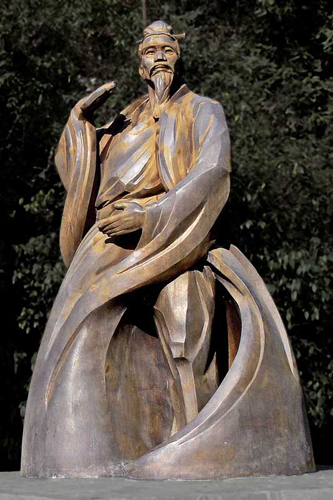
"Zhang Sanfeng saw a burst of golden light where the clouds meet the
mist-shrouded peaks.
A thousand rays of marvelous qi spun and danced in the Great Void.
The Immortal [Zhang
Sanfeng] hurried to the spot but saw nothing. He searched where the golden
light had
touched down and found a mountain stream and cave. Approaching the mouth
of the cave,
two golden snakes with flashing eyes emerged. The Immortal swished his
duster and the
golden light came down. He gazed on it and realized that it was two long
spears about seven feet five inches. They seemed to be made of rattan, but were not
rattan; seemed
of wood, but were not of wood. Their quality was such that swords could
not harm them
and they could be soft or hard at will. A rare glow emanated from within
[the cave], and looking deeper, he found a book. Its title was Taiji Stick-Adhere Spear
and its destiny
was to be transmitted to the world. He grasped the principles of the book
and analyzed
all of its marvels. All of the words in the book were written in the form
of poems and
songs. Today we cannot understand all the principles and marvels of the
spear, but Master Zhang extracted the essence of every word and transformed them into a
series
of postures. All men can now study and learn this art."
- Quoted by Barbara Davis, The Taijiquan Classics, 2004, p. 29
Translated by Dougleas Wile, T'ai-chi Touchstones, 1993, p.
138.
"A Native of I-Chou in Liao Tung Province. An external master and court
official of the Yuan dynasty (1279-1368), other sources state he was born later in the Sung dynasty
(960-1279), who upon retirement retreated with disgust from the world to a Taoist monastery
on Wu Tang Mountain, where he acquired his Taoist name of San Feng. He is said to have
learned T'ai Chi Ch'uan in a dream, or after watching a bird and a snake fight. More likely,
Chang applied the Taoist health principles and knowledge of energy circulation to his vast
ability in external kung fu, thus creating something really different - a martial art that dos not
use muscle power as a primary source of movement, but Chi. Records available in the monastery on
Wu Tang Mountain do indeed mention him. Descriptions picture him as being seven feet
tall, with the bones of a crane and the posture of a pine tree (whatever that is supposed to
mean), whiskers
shaped like a spear, winter and summer wearing the same bamboo hat, carrying a
horsehair duster and being able to cover 1000 Li in a day."
- Master
Chang San Feng
"A second legend attributes the same Zhang Sanfeng to be living in the
Yuan Dynasty. In this story, while studying the mysteries of Taoism and trying to
get to grips with the secrets of immortality, he observed the posturing of
numerous animals. One day he saw a snake and crane fighting and was inspired, by the
Yin and Yang qualities of their attacks and evasions, to develop the art of
Taijiquan.
So Zhang Sanfeng is accredited with restructuring martial arts along
inspirational lines. As a Taoist monk, he connects the art with the philosophy of Yin and
Yang, the I'Ching and its Paqua diagrams. The connection between Taijiquan, Lao
Tzu, the Tao Te Ching are implicit in the legend of Zhang Sanfeng."
- Dick
Watson
"Zhang Sanfeng was a semi-mythical Chinese Taoist
priest, who is believed by some to have achieved immortality. His legend varied
from either the late Song Dynasty, Yuan Dynasty or Ming Dynasty. His name was
Zhang Junbao 張君寶, before he became a Taoist. (Zhang Sanfeng—simplified Chinese:
张三丰; ancient Chinese: 張三丰; pinyin: Zhāng Sānfēng; English spelling: Chang San-feng;
variant 張三豐. Pronunciation keeps the same.)
As a legendary cultural hero, Zhang Sanfeng is credited by
modern practicers as having originated the concepts of neijia (內家), in other
words, the soft, internal martial arts. To put it concretely, the Taichi Quan is
one of the neijia kungfu, which is the result of a Neo-Confucian syncretism of
Zen Buddhist Shaolin martial arts combined with the principles of his Taoist
neigong. In legends, he is also associated with the Taoist monasteries at Wudang
Mountains in Hubei province. Stories from the 17th century onward recorded that
he initiated the internal martial arts. In the 19th century and later, the
credit for the creation of Taichi Quan went to him.
In addition, Zhang Sanfeng is said to have been an expert in
the White Crane and Snake styles of Chinese martial arts, as well as in the use
of the Chinese straight sword. According to the documents preserved within the
Yang and Wu family's archives, the name of Zhang Sanfeng's master was Xu
Xuanping 許宣平, who was said to be a hermit poet and Taoist Tao Yin master in Tang
Dynasty.
The Taichi Quan families who ascribe the foundation of their
art to Zhang generally, and celebrate his birthday on the 9th day of the 3rd
Chinese lunar month. Owing to his legendary status, his name frequently appears
in Chinese novels and action films as a spiritual teacher and master of martial
arts."
- Wudang Kungfu
Foundation Founder Zhang Sanfeng
Return to the Main Index for this Webpage
"Mount Wudang, also known as Can Shang Mountain or Tai He Mountain, is located in the Qin Ling Mountain Range of northwestern Hubei Province. Because the scenery around Mount Wudang is so majestic and beautiful, it has been given the name 'The Famous
Mountain Under Heaven.' Wudang is a major center for the sudy of Daoism and self-cultivation.
The legendary founder of Wudang wushu was Zhang San Feng. Zhang San Feng was a Daoist who lived in these mountains to cultivate the Dao during the Ming Dynasty.
Zhang San Feng was born in 1247 A.D. in the area of what is known today as Liao Ning.
Zhang San Feng is a very famous figure in the history of Chinese wushu. His martial abilities and healing techniques were superb and he was known to have cured many people of illnesses. This brought about great admiration from the common people.
The emperor of the Ming Dynasty erected a monument on the mountain to commerate the contributions of Zhang San Feng. During Zhang's younger years he met Daoist Huo Lung (Fire Dragon) with whom he studied the Dao. After attaining the Dao, Zhang moved to Wudang Mountain and cultivated an additional nine years. Many historical documents suggest that Zhang San Feng was the person responsible for synthesizing the wushu of the common people with the internal methodology and philosphical principles of Daoism.
Wudang wushu is primarily known for its internal styles.
Zhang San Feng created Wudang wushu by researching the basic theory of Yin and Yang, the Five Elements, and the Eight Diagrams (Ba Gua). Wudang wushu has a very close relationship with the theories of Taiji, Yin and Yang, the Five Elements, the Eight Diagrams, and the Nine Palaces. Zhang San Feng was able to incorporate the Daoist practice of changing the Essence into Internal Energy , Internal Energy into Spirit,
and Spirit into Emptiness to form the theory of Wudang wushu. "
- Introduction
to Wudang Martial Arts
Return to the Main Index for this Webpage
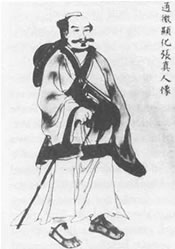
Chang San-Feng
Patriarch of the Wu-Tang-Shan Sect of Complete Reality Taoism
"Chang the Immortal, Who Understands the Subtleties and Reveals the
Mysteries."
The
Shambhala Guide to Taoism by Eva Wong, p. 89
"When your nature is stable, energy naturally returns.
When energy returns, Elixir spontaneously crystallizes,
In the pot pairing water and fire.
Yin and yang arise, alternating over and over again,
Everywhere producing the sound of thunder.
White clouds assemble on the summit,
Sweet dew bathes the polar mountain.
Having drunk the wine of longevity,
You wander free; who can know you?
You sit and listen to the stringless tune,
You clearly understand the mechanism of creation."
- Ancestor Lu, Ancestor Lü's Hundred-Character
Tablet
Translated by Thomas Cleary, Vitality,
Energy, Spirit: A Taoist Sourcebook, 1991, p. 185.
Chang San-feng's Commentary on Ancestor Lu's
Hundred-Character Tablet, pp. 186-191.
"There are 781 male immortals and 120 female immortals recorded in Lishi
zhenxian tidao
tondjian 歷世真仙道體通鑒, or a History of True Immortals edited by Taoist
Zhao Daoyi 趙道一
in 1276. “Wudang alchemist Zhang Sanfeng” is nowhere to be found. This work is
collected
in the Taoist Canon. (Zhao Daoyi) There are 21 Wudang Mountain
Taoist Immortals
specifically recorded in Wudang fudi congzhenji 武當福地總真集, or the
Complete Biographies
of Immortals from Auspicious Wudang Mountain edited by Wudang Taoist Liu
Daoming
劉道明 in 1291. “Wudang alchemist Zhang Sanfeng” again is nowhere to be found. The
work
also is collected in the Taoist Canon. (Liu Daoming) In Yuan
yitong zhi 元一統志, or a
Cohesive History of Yuan Dynasty edited by Bei Bolan 孛勃蘭 and Yue Xuan 岳鉉,
there
are 11 prominent Buddhist and Taoist Adepts recorded, “Wudang alchemist Zhang
Sanfeng” is not to be found. The editing of this work began in 1285, and
completed in
1303. (Bei Bolan) We find no traces of “Wudang alchemist Zhang Sanfeng” in
the
following related local Gazetteers: Xiangyang junzhi 襄陽郡志, or
Xiangyang Prefecture
Annuls, (Zhang Heng) Xiangyang fuzhi 襄陽府志, or Xiangyang Prefecture
Annuls,
(Hu Jia) Huguang tujingzhi 湖廣圖經志, or the Annuls of Charts and Records
of
Huguang, (Wu Yanju) Huguang congzhi 湖廣總志, or the Cohesive Annuls
of Huguang,
(Xu Xuemo) Xiangyang fuzhi 襄陽府志, or Xiangyang Prefecture Annuls,
(Chen E) Junzhouzhi 均州志, or Junzhou Annuls (Dang Juyi), Junzhou xuzhi
均州續志, or the
Continued Junzhou Annuls, (Jia Hongzhao) Dayue taihe shanzhi 大岳太和山志,
or the Great Taihe Mountain History, (Shen Dan) Dayue taihe shanzhi
大岳太和山志,
or the Great Taihe Mountain History, (Lu Chonghua) and Dayue taihe
shanzhilue
大岳太和山志略, or the Concise Taihe Mountain Annuls. (Wang Gai)."
-
Literati
Tradition: The Origins of Taiji. By Bing YeYoung.
A person calling themselves "Sifu" wrote to me on 1/24/2006, and criticized this webpage as follows:
"Chang San-Feng was real It's very disrespectful to "portray"
Chang San-Feng as a "imagery” figure. Please don't have false information
on your Web Page... He did exist, the so called common years that he lived
(1247-1447 AD) is just a “estimated range”. Chang San-Feng (also known by
different spellings ex. Zhang Sanfeng) was the “original creator” of the 13
original movements of Tai Chi Chuan.
One just has to look, at the old book of
“The Tai Chi Classics”, to see his teachings.
It not only, insults the
original master, of all forms Tai Chi Chuan, but it also shows lack of
knowledge, history, and understanding of the art. I hope you remove all false
references about him, from your website. I am from direct Yang family lineage. Thank You for reading the above. Sifu"
[I did write back to "Sifu," however the email [not@happy.com]
bounced. I do believe
that my webpage does try to give a fair and reasonable accounting of the
stories
and legends about Master Zang San Feng. A number of experts and scholars argue
that Zhang San Feng is not the inventor of Tai Chi Chuan internal
martial arts, and place its origins in the Chen style of Tai Chi Chuan. ]
"It was said that Zhang-Sanfeng,
originally named Zhang-Quanyi, nicknamed Sanfeng, was born in Yizhou City,
Liaoning Province and was tall and strong, with tortoise shape and swan bone,
big ears and round eyes, hard beards and moustaches. He always wore a coir
raincoat and a pair of straw scandals. No matter in summer or winter, he lived
in the lonely and deep mountains or traveled in the crowded cities. He could
remember what he had read just by one look and talked nothing but moral,
kindness, faith and filial piety. He could talk with the gods and understand
Taoism, so he could forecast the future and solve all the difficulties in the
world. He could live without a meal for five days, even for two or three months;
He could penetrate the mountain and drive the stones when he was happy; he lived
in the snow when he was tired; He traveled here and there without any trace, so
all the people at that time were amazed at him and thought him one of gods.
Wudang Taoist medical cultivation has a long history,
especially the inner medicine, which is to cultivate the breath into medicine so
as to make one strong and healthy, and prolong the lifespan by way of breathing.
Zhang-Sanfeng had a profound cultivation in inner medicine. He said in On
Taoism"To cultivate the mood before cultivating the medicine; to cultivate the
character before cultivating the good medicine; when the mind is steady, the
medicine will come naturally by itself; when the mood and character have
cultivated, the good medicine will be in reach", which figuratively explained
the progress of medicine cultivation. He had written many books on medicine such
as The Gist of Gold Medicine, The Secrecy of Gold Medicine, A Song of Inner
Medicine, Twenty-four Principles of Rootless Trees, Taoist Song of Earth Element
and Real Immortal, which had been published in the Ming Dynasty. Later, the
people had compiled them into The Full Collection of Zhang-Sanfeng's Works, with
eight volumes.
Zhang-Sanfeng was not only profound in medicine cultivation
but also in martial art, especially good at boxing and swordplay. He, on the
base of Taoist theories, such as the naturalness of Taoist theories, keeping in
a humble position and so on, had combined Taoist internal exercises, guarding
skills of regimen, boxing acts of martial art, military sciences of militarists
into one, and then created Wudang Boxing, which takes the internal exercises as
the body, attacking as the purpose, regimen as the first important thing,
self-protection as the main principle, and to defeat the tough with a tender
act, charge the active by the still movement and attack the opponent with his
own force, strike only after the opponent has struck. From the Ming Dynasty,
martial art world have respected Zhang-Sanfeng as the founder of Wudang Inner
Boxing and Taiji Boxing. Wudang martial art, through many generations'
succession and development, has become one important school among China martial
art and spread in the folk with a long and profound influence."
- The
Founder of Wudang Tai Chi Zhuan - Zhang San-Feng
"Chan San-Feng has become a mythical figure, but so has Jesus, and look
what is said about everything he did! I think that Chan San-Feng did exist, as
Taijiquan was passed from Master to Student heart to heart, so it must have started in a
human heart. It is just that the early forms of religion were magical and mythical in
nature; in the verbal story telling tradition. I am sure they were both real
characters. I have
also studied the San-Feng Taijiquan from the Wudang tradition with Máster Tian
Liyang from Wudang since 2000. So I have a bit of direct background knowledge,
most of it is in German. If you want to know more about the subject I can
recommend "Wudang – Mountain of the Immortals" from Abbot Wang Guangde, which
also has an English version."
- Philip Stanley, Qigong,
email 1/30/06 to Mike Garofalo
"While kungfu was developed as an external,
combative form of physical discipline, Zhang San-feng (living sometime
in the period 960-1279 AD) was creating a technique that would make him a
legendary patriarch of latter-day Tai Chi Chuan. He is often attributed to the
time of Song Dynasty, though the most reliable and accepted evidence indicates
that Zhang San-feng was the former magistrate and scholar of Confucianism for
Chung Shan County, and was a native from Yi Zhou in today's east Liaoning
Province. According to this evidence, he was born on the ninth day of the fourth
moon of 1247 AD, in the Yuan Dynasty (1206-1368AD).
His fame became established after he had completed a ten-year devotion
at the Shaolin Monastery where, besides studying the Chinese Buddhist doctrines,
he learned the " exoteric martial arts," wai kung . Zhang San-feng went
on to study Taoism at the K'o Hung Mountain Monastery, which led him to wander
as a hermit until he reached the Taoist enclave at Wudang Shan, sometimes
referred to found in Hubei Province. Here he founded the first major esoteric of
internal school, nei kung , of martial arts. This was the birthplace of
modern Tai Chi Chuan.
A Chinese Merlin, Zhang San-feng laid out the initial moves of the Tai
chi form, based on inspirational and dreams he had experienced. Composed much
later, the Tai Chi classics state that one night he dreamed of a Taoist Immortal
advising him to reform his strenuous training methods, to relax the rigors he
had developed as part of his earlier Shaolin training. The message of the dream
troubled him for a long time, until one day he spotted a snake and a crane in
deadly combat.
The snake and the crane also have a magical significance in
the West. Having deciphered obscure Western alchemical texts, Jung found that the
snake symbolized the "chthonic," with earth energy represented as a dragon or
physics, which makes up the element equivalent to yin in Chinese philosophy.
Distinct from this creeping reptile, the crane stands for the aerial, the
spiritual, psychic energy that is the yang principle. Therefore, the snake and
the crane present two principle opposites of Nature in both Chinese and European
alchemy. In Tai Chi Chuan, the Snake Creeps down has a martial application, but
it also signifies the descent into Underworld. "Redemption" takes places in the
next move, when the " Golden Bird (crane) stands on One leg," portraying the
ascent of the spirit. These movements, then, comprise paradise lost and found"
- Zhang San Feng,
Wudang Taoist Culture Center.
"After verification according to different historical materials, Zhan
Sa-Feng, with the original name Zhan Jun-Bao and the Taoist name Yu-Xu Zi, is now known to be of
the
Song Dynasty. He was indifferent to fame and wealth and had no interest in
the official career given by the authorities. After declining an official
position and dispatching
his property to his clan, he traveled around the country.
He stayed at Hua Mountain in northwestern China for several years to deepen his
own self-training. Afterwards, he left Hua Mountain and lived on Wu-Dan Mountain
in Central
China, leading a hermit's life.
Zhan Sa-Feng was versed in Shao-Lin Gong-Fu from a young age. After
contacting the internal Gong-Fu transmitted from the line of Li Dong-Feng and Jia De-Shen, he
changed
his ways and turned to internal cultivation. He concluded four principles
about his own
system: First, control motion with repose. Second, conquer hardness
with softness. Third, surmount swiftness with uniformity. Fourth, overcome the many with
the few.
Thus Zhan Sa-Feng composed a complete internal Gong-Fu system. Because
this internal
Gong-Fu was explained with ancient Tai-Ji principles, it is called Tai-Ji
Gong-Fu by the people."
- Albert Liu, Nei Jia Quan: Internal Martial Arts, 2004, p.
318
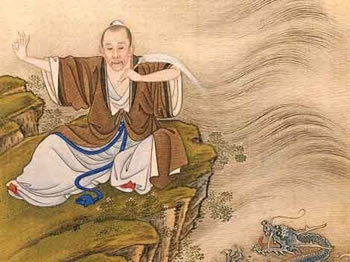
"Taoism has a complicated system of
immortals and deities. They fall roughly into three categories: natural gods,
such as those of the sun, moon, wind, rain, and earth; deified mortals of great
merit, such as role models for fidelity, filial piety, benevolence and justice;
and daily functional gods, such as the door, kitchen and fire gods. Each has its
own characteristics, but all represent justice and benevolence and have the
common purpose of helping the needy and punishing evildoers.
Unique among the large body of immortals believed to live on
Wudang Mountain was the martial Taoist monk, Zhang Sanfeng. He could walk 500
kilometers daily, fast for months at a time and vanish and reappear in an
instant, according to The History of the Ming Dynasty. The founding emperor of
the Ming Dynasty Zhu Yuanzhang had tried unsuccessfully to employ Zhang Sanfeng
in his service, but the monk was notoriously difficult to pin down. Emperor Zhu
Di wrote an extraordinarily modest and respectful letter to Zhang Sanfeng,
requesting a meeting, but Zhang declined. No mortal that valued his life would
have dared to behave in such an offhand manner towards the emperor, but as Zhu
Di regarded Zhang Sanfeng as a deity he was not affronted. On the contrary, to
express his sincerity, the emperor ordered construction of the Yuzhengong
(Meeting the True Man Palace) on Wudang Mountain and the enshrinement of a
statue of Zhang Sanfeng in its main hall. This unheard of imperial honor caused
a storm of speculation as to the emperor’s motivation for such an act of
obeisance. Some thought it was because Zhang Sanfeng was actually a living deity
versed in the arts of necromancy and distillation of life-prolonging elixirs.
Others surmised that Zhang knew the whereabouts of the missing emperor Jianwen,
whose reappearance was the emperor’s greatest dread. Since the Zhu Di epoch,
however, Zhang Sanfeng has been regarded as a great martial artist and founder
of Wudang kungfu, rather than immortal.
Wudang kungfu is equal in reputation to Shaolin kungfu, the
former being generally accepted as the southern, defensive and the latter as the
northern, offensive school of martial arts. One of Zhang Sanfeng’s most esteemed
contributions to Chinese martial arts was his unequivocal statement that the
ultimate purpose of practicing kungfu was to maintain physical health. Taoists
were popularly associated with elixirs and alchemy, but Zhang Sanfeng was one
outstanding exception. In a letter to Emperor Zhu Di he wrote, “It is better not
to believe in alchemy and alchemists….. The amplitude of Dao and abundance of
virtue are the best remedies, and a serene mind and absence of desires bring
longevity.” Zhang created and practiced an “inner elixir kungfu,” known today as
qigong, or respiratory kungfu -- a breathing technique that aligns the body and
the spirit."
-
Mount
Wudang Abode of the Immortals and a Martial Monk
"In the Chinese history there existed two men called Zhang San Feng. One
was born in the Sung dynasty (960-1279), who upon retirement retreated with disgust from the
world to a Taoist monastery on Wudang Mountain, where he acquired his Taoist name of
San Feng.
He is said to have learned T'ai Chi Ch'uan in a dream, or after watching a bird
and a snake fight. More likely, Zhang applied the Taoist health principles and knowledge of
energy circulation to his vast ability in external kung fu, thus creating something
really different - a martial art that dos not use muscle power as a primary source of movement,
but Chi.
Later he became an accomplished Inner KungFu master after long term practice
with several teachers. Therefore, he was regarded as the common founder of all
Taichi boxing schools.
Another Zhang San Feng was a native of I-Chou in LiaoTung Province. His scholar
name was Chuan Yee and Chun Shee. He lived in Yuan dynasty (1279-1368).
The Chinese old book Ming History bearing records available in the
monastery on Wudang Mountain does indeed mention him. Descriptions picture him as being seven feet
tall, with the bones of a crane and the posture of a pine tree, whiskers shaped like a
spear, winter and summer wearing the same bamboo hat, carrying a horsehair duster
and being able to cover 1000 Li in a day, sometimes eating 50 Kg food in one
meal, sometimes keeping fasting as long as several months, possessing amazing memory as to recite a scripture fluently after reading it just one time."
- Mount Wudang
and Wudang Kung Fu
"Chang San-feng was born sometime
between 600 and 1600 AD, perhaps sometime during the Sung Dynasty, or maybe the
Yuan Dynasty, but exactly at midnight on the fourth of April, 1247, and he lived
precisely between the years 960 and 1126. His family came from I-Chou in the
Liao-tung Peninsula. He spent many years at the Temple of the Jade Void,
becoming expert in Shaolin kung fu. Early on, it was discovered that he could
recite Taoist classics after only a single reading. As he traveled, he became
wise in the meditative and martial arts. At the age of sixty-seven, he
retired to the Wu Tang Mountains, where he built himself a cottage. At rest, he
meditated, returning to the Original Source; when active, he roamed the Three
Mountains and the Five Peaks, gleaning the finest elements and subtle chi of
Heaven and Earth and circulating them with breathing exercises. During this
time, his reputation spread far and wide. The first Ming emperor sent a
messenger to find him and bring him to court, but the errand was unsuccessful.
Throughout his life, Chang took pains to conceal his
achievements. He did not want to appear at court and so worked hard to seem mad.
Everyone agrees that he did not keep himself neat and clean; Chang Lar-tar
(Sloppy Chang) or La T’a (Dirty Fellow) often acted as if no one was around,
spitting, farting, and scratching. He liked to tease people. He was very
virtuous and often displayed such great mirth that is was impossible to remain
melancholy in his presence. Winter and summer, he wore the same rude bamboo hat,
the same old, ragged priest’s robe. Instead of a staff, he carried a horsehair
broom. Sometimes he would eat a bushel of food at a time, then again, he
wouldn’t eat for weeks. He never ate grains or cereals at all.
His picture can be seen at the White Cloud Temple in Beijing.
He was seven feet tall, had bones like a crane; his posture was like a pine
tree, his face round like an ancient moon, with kind brows and generous eyes and
whiskers shaped like a spear; he was a big man, shaped like a turtle (a symbol
of longevity), with a crane’s back, large ears, round eyes, and beard like the
tassel on a spear. He was very tall, his beard reached his navel, his hair
touched the ground.
He had six hobbies: sword playing in moonlight, playing tai
chi in the dark, mountain climbing on windy nights, reading the classics on
rainy nights, meditating at midnight in the full moon, and playing the lute.
One day, the Immortal suddenly saw a burst of golden light
where the mists shrouded the peaks. A thousand rays of chi spun and dance in the
Great Void. He searched where the golden light touched down and found a mountain
stream issuing from a cave. Approaching the cave, he saw two golden snakes with
flashing eyes. He swished his horsehair duster and realized that they were
really two spears of such quality that swords could not harm them. Master Chang
also discovered in the cave a glowing book of songs and poems from which he
extracted the essence, transforming them into the postures of the art of tai chi
spear.
Chang used the movement “diagonal flying” to break firewood
in the forest, and he had a large pet ape who collected his firewood for him. In
fact, the ape so often had an opportunity to watch the Master practice that, in
faithful imitation, he developed a simian version of tai chi. Upon being
attacked by a python, Chang grasped the serpent at either end, and using the
technique of “parting the wild horse’s mane,” he tore it into pieces. Once,
encountering a tiger in the mountains, he applied the skill of “bend the bow to
shoot the tiger”—first he turned to avoid the tiger’s rush, then grasping the
two hind legs as the beast passed, he tore it in half."
-
Chang San-Feng: His
Life and Deeds. By Jack McGann and Christopher Dow. An
apocryphal biography of the legendary founder of Tai Chi Chuan. An
interesting short biography with some new stories about Master Zhang.
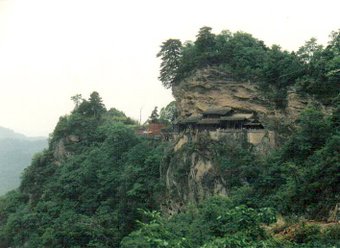
Wudang Mountain Temple
"The Wudang Mountains (Simplified Chinese: 武当山; Traditional Chinese:
武當山; Hanyu Pinyin: Wudāng Shān), also known as Wu Tang Shan or simply Wudang, are a small mountain range in the Hubei province of China, just to the south of the manufacturing city of Shiyan.
In years past, the mountains of Wudang were known for the many Taoist monasteries to be found there, monasteries which became known as an academic centre for the research, teaching and practise of meditation, Chinese martial arts, traditional Chinese medicine, Taoist agriculture practises and related arts. The monasteries were emptied, damaged and then neglected during and after the Cultural Revolution of 1966-1976, but the Wudang Mountains have lately become increasingly popular with tourists from elsewhere in China and abroad due to their scenic location and historical interest. The monasteries and buildings were made a UNESCO World Heritage Site in 1994. The palaces and temples in Wudang, which was built as an organized complex during the Ming dynasty (14th–17th centuries), contains Taoist buildings from as early as the 7th century. It represents the highest standards of Chinese art and architecture over a period of nearly 1,000 years."
- Wudang Mountains - Wikipedia
"Twentieth-century martial arts historians Tang Hao and Xu Zhen in
independent efforts
disputed the role of Zhang Sanfeng as founder of taijiquan, as have others
since. We can
see that not only does the internal evidence of the Taijiquan Classics
contradict Zhang's
role, but Chen family material, ostensibly earlier and closer to the source, has
no record
of Zhang, regardless of the assertion that the founder of Chen style is said to
have incorporated "Daoist ideas" into his proto-taijiquan style.
Moreover, if Zhang had invented taijiquan, we would expect to find trace of Zhang in Chen Family
Village, or
to find traces of taijiquan in other locales in which Zhang and his followers
may have
been. Additionally, neither Zhang's official biographies nor his
attributed writings on
Daoist topics mention boxing. Portraits of Zhang, no matter how far
removed in time from when he lived, or how generic the style of painting, always depict Zhang in
a
contemplative stance, with no hint of boxing in the picture."
- Barbara Davis, The Taijiquan Classics, 2004, p.
18.
"The origins of Tai Chi Chuan go back to around the Sung Dynasty (960-1279) in China. As the story goes, Chang San-feng, a Taoist priest, was meditating on Wu-Tang Mountain, in Hupei province. One day he heard a noise outside and found that a bird was attacking a snake. Chang watched as the bird attacked the snake's head and the snake yielded at his head and struck with his tail. Then the bird attacked the snake's tail and the snake yielded at his tail and attacked with his head. When the bird attacked the snake's belly the snake yielded at the belly and attacked with both his head and his tail. In the end the bird gave up and flew away. Chang was so impressed with the beauty and efficiency of the snake's defense that he decided to create a martial art using the yielding (yin) and attacking (yang) method of the snake. He combined the thirteen postures with Taoist philosophy and exercises to create Tai Chi Chuan. Chang then wrote what is known as the Tai Chi Chuan
Classic, a very important read for those studying Tai Chi Chuan."
- Kent's Tai Chi Center, The
Thirteen Postures
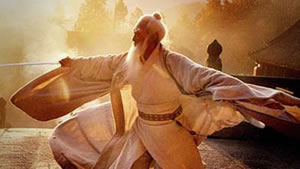
"The evidence for the existence of Zhang San Feng is impressive,
although some scholars say
that he was a myth. Erected on Wudang Mountain are two huge stone tablets
honoring him as a Taoist saint, one decreed by the Ming Emperor Seng Zu, and the other by the
Ming Emperor Ying Zong. The Imperial History of the Ming Dynasty records
that Zhang San Feng
was born in 1247, learned Taoism from a Taoist master called Fire Dragon at
Nanshan Mountain
in Shenxi, cultivated his spiritual development for nine years at Wudang
Mountain, was known
by the honorific title of "the Saint of Infinite Spiritual Attainment', and
was the first patriarch
of internal martial arts. The Records of the Great Summit of Eternal
Peace Mountain mentions
that he studied the yin-yang of the cosmos, observed the source of the longevity
of tortoises
and cranes, and attained remarkable results. Collections of Clouds and
Water describes him as
carrying his lute and sword on this back, singing Taoist songs, work in the
mountains, and studying the marvelous secrets of the cosmos."
- Wong Kiew Kit, The Complete Book of Tai Chi Chuan, 1996, p. 21
"Chang San-feng is
credited with developing the Chinese internal system known as Taijiquan. He was
born in 960, 1247 and again in 1279 AD. A Native of I-Chou in Liao Tung
Province. An external master and court official of the Yuan dynasty (1279-1368),
other sources state he was born later in the Sung dynasty (960-1279), who upon
retirement retreated with disgust from the world to a Taoist monastery on Wu
Tang Mountain, where he acquired his Taoist name of San Feng. He is said to have
learned T'ai Chi Ch'uan in a dream, or after watching a bird and a snake fight.
More likely, Chang applied the Taoist health principles and knowledge of energy
circulation to his vast ability in external kung fu, thus creating something
really different - a martial art that dos not use muscle power as a primary
source of movement, but qi. Records available in the monastery on Wu Tang
Mountain do indeed mention him. Descriptions picture him as being seven feet
tall, with the bones of a crane and the posture of a pine tree, whiskers shaped
like a spear, and in winter and summer wearing the same bamboo hat, carrying a
horsehair duster and being able to cover 1000 Li in a day.
The crane - snake combat gave him the ideas that the coiled
movement of the snake was like the Taijitu (the Yinyang symbol) and contained
the principle of the soft overcoming the hard. Based upon the transformations of
the Grand Ultimate, the Yin and Yang leading to the Bagua eight Trigrams, the
Trigrams leading the 10.000 things (everything), and the Wuxing (Five movements
or phases) being the basis of their interaction, he developed Taijiquan, to
gather the Qi, cultivate it to Jing (essence), and hence transform it into Shen
(spirit); all waxing and waning, movement and stillness, action and non-action
embodied in the I-Jing.
There are many stories of exactly when Taijiquan was
developed by Chang San-feng and no one today knows the accurate story. Some of
the accepted facts, however, are that he was a very intelligent man, he studied
Shao-Lin Chuan for about ten years and mastered it, and with the foundation in
Shao-Lin Chuan he developed the original thirteen postures of Taijiquan."
-
The Myth of Chang San Feng, Jung Tao School of Classical Chinese Medicine
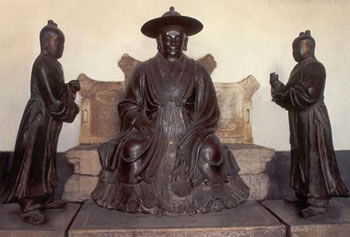
"The legends of “Zhang Sanfeng’s creation of
taiji quan” continued in some of the most important
modern taiji quan books, such as Xu Yusheng’s 許禹生 Taijiquan Tushi Jie
太极拳势图解, or a
Elucidation of Taijiquan Postures in 1921, Sun Loutang’s 孫祿堂 Taiji
Quanxue 太極拳學, or the
Learning of Taiji Quan in 1924, Ceng Weiming’s 陳微明 Taiji Quan Shu
太極拳術, or the Art of
Taiji Quan in 1925, and Yang Chengfu’s 揚澄甫 Tiaji Quan Tiyong Quanshu
太極拳體用全書, or the Essence and Applications of Taiji Quan in 1934, and in the oral
traditions as well. According
to Xu Zhen 許震 (1898-1967), the source of Zhang Sanfeng’s association with
Taiji quan must
have been the Yang family partisans no earlier than Guangxu 光緒 reign (1875-1904)
of the
Qing dynasty. (Xu Zhen, 112) The attribution of “Zhang Sanfeng’s creation of
taiji quan” was
seriously taken as a creed, and this creed has been concretized via lineage
records,
ceremonies, altars, and iconography to the majority of taiji quan
enthusiasts."
-
Literati
Tradition: The Origins of Taiji. By Bing YeYoung.
"Other recordings concerning Zhang Sanfeng and his Kung
Fu master history may have to be related to Huang Zongxi, who was one famous
Chinese thinker and historian in late Ming Dynasty and early Qing Dynasty. In
his books History Files In Song- and Yuan Dynasty, History Files In Ming Dynasty
and History Files Of Scholars In Ming Dynasty, he held the view many times that
Zhang Sanfeng was a famous Kung Fu master in Song Dynasty. One manuscript handed
down by Li Yifan-- who was Wu-style Taiji boxing bearer –- also carried such
message as “Taiji boxing originated from Zhang Sanfeng in Song Dynasty.”
Therefore, in today’s Kung Fu circle many martial artists generally regard Zhag
Sanfeng as the founder of both Taiji boxing and Wudang Kung Fu in Song Dynasty.
It is a general viewpoint circulating in Kung Fu arena that Taiji boxing
originated from inter Kung Fu created by Zhang Sanfeng. One collect book with
China State Library called Taiji Masters Lineage has the following messages as
“Sir Zhang Sanfeng, surname Zhang, first name Sanfeng, went to Mount Zhongnan
when he was 61 years old. There he chanced to meet one immortal called Dragon
Fire who late transferred his knowledge regarding inner alchemy to him after
knowing he was a competent practitioner.”
Later Zhang Sanfeng traveled a lot to famous resorts in the south and finally
settled down in Mount Wudang. Then ordering disciple Qiu Yuanqing to stay in
Five Dragon House, Lu Qiuyun in Southen Cave, Liu Guquan in Purple Heaven
Palace, Zhang Sanfeng constructed a house in the place where Immortal
Encountering Palace now stays. Cultivating true self for as long as nine years,
Zhang Sanfeng finally succeeded in achieving Tao. People called him an immortal
who can excise unimaginable power to restrain the bad and promote the good, and
transform all corporeal things into different forms as the he wished to do. All
the universe turns to become one thing staying in his hand waiting for him to
deal with.
Later, Zhang Sanfeng taught one set of boxing forms to Zhang Songxi and Zhang
Cuisan, which was the very original form of Taiji boxing. Because there are only
thirteen forms people called it Thirteen-Form Taiji Boxing. Among these 13
forms, stretching out, stamping, squeezing, chopping downward, picking up,
changing place, using elbow, leaning against symbolize separately the eight
trigrams, while moving forward, retreating backward, watching to the left,
turning to the right and staying in the center indicate separately the five
elements. From these specific sayings there came the name of Thirteen-Form Taiji
boxing. Based upon the Yin- and Yang-Qi theory and aimed at regulating operation
of the inner organs according to five-element theory, TaiChi boxing incorporates
many soft movements imitating cats, birds, snakes and monkeys, thus gaining the
effects of soothing the inner mental state, harmonize the operation of inner
viscera, strengthening the immune system, etc."
- Wudang Kung
Fu
"Zhang Sanfeng ("Zhang Triple
Abundance" or "Zhang Three Peaks") is a famous Taoist said to have live
between the end of the Yuan and beginning of the Ming periods. His
historical existence, however, is unproved. In early
biographies―including the one in the Mingshi (History of Ming)―he is usually
said to be a native of Yizhou (Liaoning), but other sources give different
birthplaces. According to these works he was seven feet tall and had
enormously big ears and eyes, his appearance suggested the longevity of a
turtle and the immortality of a crane, and his beard and whiskers bristled
like the blades of a halberd. He tied his hair in a knot and,
regardless of the season, wore only a garment made of leaves. In his
youth, Zhang is supposed to have studied Buddhism under the Chan master
Haiyun (1021-56), but then mastered neidan and reached immortality.
He was known for his extraordinary magical powers as well as his ability to
prophesy.
In the first years of the Ming period, Zhang reportedly
established himself on Mount Wudang (Wudang Shan, Hubei), where he lived in
a thatched hut. With his pupils he rebuilt the mountain monasteries
destroyed during the wars at the end of the Mongol dynasty. From Mount
Wudang, Zhang went to the Jintai guan (Abbey of the Golden Terrace)
in Baoji (Shananxi), where he announced his departure, composed a hymn, and
passed away. Later he came back to life, travelled to Sichuan, and
visited Mount Wudang.
The belief in the real existence of Zhang Sanfeng during the
Ming Dynasty is reflected in the emperor's continued efforts to locate him.
The search for Zhang started in 1391 by order of the Hongwu Emperor
(1368-1398) and was extended from 1407 to 1419 by the Yongle Emperor
(1403-1424). Both sent out delegates several times, but they all
returned without success. Promoted by the Ming emperor's interest, a
cult developed around Zhang that spread widely and lasted until the later
years of the Qing dynasty.
As time went on, the legends about Zhang Sanfeng multiplied
and became increasingly exaggerated. Zhang is known as the founder of
taiji quan (a claim without historical evidence) and the patron saint
of practitioners of this technique. During the sixteenth and
seventeenth centuries, a connection to the sexual techniques (fangzhong
shu) was also established and texts dealing with these practices were
ascribed to him. The belief that Zhang was the master of Shen Wansan,
a popular deity of wealth, led to his own identity as a god of wealth in the
seventeenth century. The Western Branch (Xipai) of neidan and
various Qing sects also regarded Zhang Sanfeng as their first patriarch."
- Martina Darga, Encyclopedia of Taoism, 2008, p. 1233-35
"At the age of five, Zhang Jun Bao suffered from an illness and lost his eyesight. His father heard that some Daoist priests in a Daoist temple had an incredible way of curing illness; so, he took Zhang Jun Bao there. Within a week, he was cured and the whole family was more than happy. The Daoist priest loved Zhang Jun Bao and took him as a disciple teaching him both writing and martial arts. Like all fathers, his father wished him every success. Zhang Jun Bao was expected to take the state exam for a career in the government. However, he was not interested in becoming a politician or minister. He loved martial arts and visited many ancient temples. When he came to Yan Jing, he took up a local government post through the relationship of a good friend. Since he did not enjoy this kind of life, Zhang Jun Bao quit and returned to Liao Dong where he spent most of his time in a deserted temple..
One day at the temple, a Daoist priest approached him. They talked throughout the night, and treated each other as old friends, regretting not having met earlier. As they parted, Zhang Jun Bao missed living a life of solitude, wanting to be free like the clouds and birds. He spent the next few years visiting various places, learning martial arts and becoming famous. When he was visiting ShanXi Province, he realized that the Daoist priest he met earlier was Qui Chu Ji, the disciple of the renowned Wang Chong Yang.
Zhang Jun Bao moved to the Jin Tai Temple in Bao Ji and was accepted by the respected Daoist Huo Long as a disciple. He became versatile in Daoism and named himself San Feng 三丰, which means heaven and earth. (In the 8 trigrams, San 三 represents heaven, or qian 乾. Feng 丰 represents earth, or kun 坤 .)
Zhang San Feng
came and went without shadow. Settling down in
Wudang Mountain, he was inspired by watching a snake fight a bird. He
thought about martial arts, learned advantages from others, and combined Daoist
fighting techniques in order to create the Tai
Ji Quan 13 style. The Tai Ji Quan 13
style, also known as Nei Jia Quan or Wudang Nei Jia Quan, has formed
the basis of Wudang Internal Martial Arts."
- Wudang Traditional Internal Kung
Fu Academy
"Chang San Feng, the legendary martial arts master, is
reputedly the father and founder of Tai Chi Chuan. According to legend, he
established a monastery on the mountain called Mol-Don. Here he
taught his students the centuries old principles and methods of the soft fist
which he synthesized and codified. Whenever the term Mol-Don is
mentioned, it is automatically associated with Chang San Feng and Tai Chi
Chuan."
-
Tai Chi Chuan: The Philosophy of Yin and Yang and its Application. By
Douglas Lee. Burbank, California, Ohara Publications, Inc, 1976.
"In 1412, while construction of the
Forbidden City was underway, the emperor dispatched 300,000 artisans and
military and civil builders to Wudang. Their task was to create a Taoist
Imperial Palace - a massive project in which the emperor invested the tributes
and taxes from nine affluent southern Chinese provinces. Thirteen years later,
33 clusters of Taoist temples, pavilions and bridges, including the Gilded Hall
and the Taihegong, Qingweigong, Zixiaogong, Chaotiangong, Nanyangong,
Huilongguan, Longquanguan, Fuzhenguan and Yuanheguan temples, had been built
along the contour line of a 70-km path from downtown Junxian to the Tianzhu
Peak.
At one time there were 400 temples, administered by 10,000 or
so monks, on Wudang Mountain. The complex covered a 1.6 million sq m area --
twice that of the Forbidden City. Emperor Yongle personally monitored the Wudang
project. He took great care to ensure that the Taoist principle of respecting
the laws of nature in all phases of construction was upheld. Building materials
were transported from elsewhere to avoid disturbing the natural symmetry of
Wudang’s woods and rocks, and the emperor saw to it that buildings blended
naturally and aesthetically with their environs. He bestowed on Wudang the title
of “No. 1 Mountain under Heaven” and elevated Zhenwu, god of the North, to the
status of All Mighty -- the highest divinity in the Taoist pantheon."
-
Mount
Wudang Abode of the Immortals and a Martial Monk
"Once, when members of the royal Mongolian family of the Yuan Dynasty were hunting in the mountains, they ran across Chang as he was picking herbs. Though aware that the Mongolians were excellent bowmen, he was offended by their pomposity, so that when they ordered him to leave, he refused. Angrily he said to the prince, “Your highness hunts with a bow and arrow, but I use only bare hands.” Suddenly two hawks flew by, and Chang leapt up, caught them, then dropped silently to the ground. Chang stood a bird in each of his palms, but no matter how hard they tried to fly away, they could not escape, such was his yielding ability. Then Chang said to the shocked prince, “I have mercy on living creatures and do not want to hurt the birds.” He let the birds fly away. One of the guards was so incensed that he drew his bow and shot an arrow at Chang, but the Master caught the arrow in his teeth. Then, holding the arrow in his fingers, he threw it at a tree, where it buried deep into the wood. “I have no need of violent weapons,” he commented dryly.
Some time after creating tai chi, Chang was ordered to appear at the court of
the Emperor Tai-tsu. On the way, while crossing a bridge, he was attacked by a
band of one hundred brigands who thought him easy prey. Within moments, the
fight was over, all the outlaws lying unconscious on the ground. Chang walked
away unscathed. Later, when the outlaws awoke, they swore that the old man
hadn’t even used his arms or legs but had merely shrugged them aside as they
attacked, flinging them into unconsciousness. When Chang reached the palace, the
emperor conferred on him the title, “T’ung-wei’hsien’hua chen-jen,” which meant,
“The spiritual man who understands the power of the occult.”"
-
Chang San-Feng: His
Life and Deeds. By Jack McGann and Christopher Dow. An
apocryphal biography of the legendary founder of Tai Chi Chuan. An
interesting short biography with some new stories about Master Zhang.

Treatise on
Tai Chi
The Principles of T'ai Chi Ch'uan
Attributed to the Taoist Master Chang San-Feng
There are numerous translations and commentaries on the short statement of
the
"Principles of T'ai Chi Ch'uan" attributed to Chang San-Feng. One can find
able
translations and commentary by Jou Tsung-Hwa (1980), Liao Waysun (1977),
Benjamin
Pang Jeng Lo (1979), Yang Jwing-Ming (1996, 1987), T.T. Liang
(1977),
Kuo Lien-Ying (1999), Almanzo Lamoureux (2002), Stuart Alve Olson (2001),
Barbara Davis (2004), and many others.
Students of Taijiquan will benefit from studying this
Taijiquan classic. A number
of versions are cited below for your consideration. The translators
or interpreters
chosen are:
A. Olson, Stuart Alve, 2001.
1A. With every
movement string all the parts together,
keeping the
entire body light and nimble.
1B. In any action, the whole body should be light and agile, or Ching
and Lin.
One should
feel that all of the body's joints are connected with
full
linkage.
1C. Once in motion, every part of the body is light and agile and
must be
threaded
together.
1D. Whenever one moves, the entire body must be light and lively,
and must
above all be
connected throughout.
1E. Once you begin to move, the entire body must be light and
limber. Each
part of your
body should be connected to every other part.
1F. In motion all parts of the body must be light, nimble, and
strung together.
1G. Move in an agile, balanced, and coordinated manner.
Once you
decide to move,
The parts of
the body should act together:
Feeling
connected and coordinated,
As balanced
as two feathers on a scale,
Strung
together like pearls in a necklace,
Agile like a
cat,
Lighter than
moonbeams,
Mobile as a
young monkey.
Master Chang San-Feng's Treatise on T'ai Chi Ch'uan, circa 1300 CE, Part 1
2A. Calmly stimulate the ch'i, with the Spirit of Vitality
concentrated internally.
2B. Chi should be stirred. The spirit of vitality, or Shen,
should be concentrated
inwards.
2C. Qi should be full and stimulated, Shen (Spirit)
should be retained internally.
2D. The qi should be excited; the spirit should be gathered
within.
2E. The internal energy should be extended, vibrated like the beat
of a drum.
The spirit
should be condensed in toward the center of your body.
2F. The ch'i (breath) should be excited, the shen
(spirit) should be internally
gathered.
2G Energize the body and quiet the gathered spirit.
Raise up awareness to draw Chi to every nerve,
Fill up the body with the strength of the excited Force,
Stir and stimulate the Chi from head to toe,
Playing the Great Drum of Inner Powers.
Keep the spirit calm within,
Vital forces tamed and quiet,
Riding the Tigress to the Temple,
Gently leading the Great Ox past the Gate;
Condensing the Elixir of Spirit in the Inner Chamber.
Master Chang San-Feng's Treatise on T'ai Chi Ch'uan, circa 1300 CE, Part 2
3A. Avoid deficiency and excess; avoid projections and hollows;
avoid
severance and splice.
3B. Do not show any deficiency, neither concavity nor convexity in
movement.
Do not
show disconnected movement.
3C. No part should be defective, no part should be deficient or
excessive,
no part
should be disconnected.
3D. Let there be no hollows or projections; let there be no
stops and starts.
3E. When performing T'ai Chi, it should be perfect; allow no
defect. The form
should
be smooth with no unevenness, and continuous, allowing no
interruptions.
3F. Let the postures be without breaks or holes, hollows or
projections, or
discontinuities and continuities of form.
3G. Move in a continuous, even and smooth manner.
Do not overextend the limbs or sully the
forms.
Flow like the
Great River
Filling all
the holes and hallows,
Unbroken,
gathered, full, unstoppable;
Seeking the
True Level, finding the Golden Mean,
Neither
excessive nor deficient in Yin or Yang;
Holding
postures as perfect as the Blue Lotus,
Moving
steadily between forms like the White Tiger,
Uniting body
and will in the Jade Furnace,
Transcending
inner and outer, starting and stopping.
Master Chang San- Feng's Treatise on T'ai Chi Ch'uan, circa 1300 CE, Part 3
Master Chang San-Feng's Treatise on T'ai Chi Ch'uan, circa 1300 CE, Part 4
Jin (Chin)
Skilled use of energy, coordinated and focused
engagement using muscular force, trained movement responses, skillful use of
interactive powers and forces,
4A. The energy is rooted in the feet, issued through the legs,
directed by the waist,
and
appears in the hands and fingers. The feet, legs, and waist must act
as
one
unit, so that whether Advancing or Withdrawing you will be able to
obtain
a superior position and create a good opportunity.
-
Stuart Alve Olson,
T'ai Chi According to the I Ching: Embodying the Principles of the Book of
Changes, 2001, Chang San-Feng, p. 36
4B. The Chin is rooted in the feet, bursts out in the legs,
is controlled by the waist
and
functions through the fingers. From the feet to the legs, legs to
the
waist,
all should be moved as a unit. By moving as a unit, one can advance
or
retreat with precise timing and the most advantageous position. - Jou, Tsung-Hwa, 1980
4C. The root is at the feet, (Jin is) generated from the
legs, controlled by the waist
and
expressed by the fingers. From the feet to the legs to the waist
must
be
integrated, and one unified Qi. When moving forward or backward,
you
can
catch the opportunity and gain the superior position. - Yang, Jwing-Ming, 1996.
4D. Its root is in the feet, it issuing from the legs, its control
from the yao, and its
shaping
in the fingers. From the feet, to the legs, and then the yao; there
must
always be completely one qi. Only then, in moving forward and
backward,
can the
opportunity and position be gained.
4E. The internal energy, ch'i, roots at the feet, then
transfers through the legs and
is
controlled from the waist, moving eventually through the back to the arms
and
fingertips. When transferring the ch'i from your feet to your waist, your
body
must operate as if all the parts were one; this allows you to move forward
and
backward freely with control of balance and
position.
4F. The motion should be rooted in the feet, released through the
legs, controlled by the
waist,
and manifested through the fingers. The feet, legs and waist must
act
together simultaneously, so that while stepping forward or back the timing and
position are correct.
4G.
A. Olson, Stuart Alve, 2001.
5A. Failure to obtain a superior position and create a good
opportunity results from
the
body being in a state of disorder and confusion. To correct this disorder,
adjust
the waist and legs.
5B. If precise timing and good
position are not achieved and the body does not move
as a
unit, then the waist and legs need more development. They may not
be
strong or flexible enough.
5C. If you fail to catch the opportunity and gain the superior position,
your mind is
scattered and your body is disordered. To solve this problem, you
must
look to
the waist and legs.
5D. Where the opportunity and position have not been gained, the
body is scattered
and
disordered. This error must be sought in the yao and the legs.
5E. Failure to do this causes loss of control of the entire body
system. The only cure
for
such a problem is an examination of the stance.
5F. If the timing and position are not correct, the body
becomes disordered, and the
defect
must be sought in the legs and waist.
5G.
6A. Likewise, upward and downward, forward and backward, leftward
and rightward -
all these are
to be directed by the Mind-Intent and are not to be
expressed
externally.
6B. This often shows when moving up or down, backwards or forwards,
left or
right.
Use internal consciousness, not external forms.
6C. Up and down, forward and backward, left and right, it's all the
same.
All of this
is done with the Yi (Mind), not externally.
6D. Upward, downward, forward, backward, left and right are all
thus. In all
of these
cases, it is yi, and not from extremities.
6E. Application of these principles promotes the flowing T'ai Chi
movement in any
direction;
forward, backward, right side, and left side. In all of this, you
must
emphasize the use of the mind in controlling your movements, rather
than the mere
use of external muscles.
6F. Up or down, front or back, left or right, are all the
same. These are all i (mind)
and not
external.
6G.
7A. If there is above, there must be below. If there is
Advancing, there must be
Withdrawing. If there is left, there must be right. If the initial intent
is
upward, you
must first have downward intent. If you want to lift something
upward, you
must first have the intent of pushing downward. Then the root
will be
severed, it will be immediately and certainly toppled.
7B. Where there is something up, there must be something down.
Where there is
something
forwards, there must be something backwards. Where there is
something
left, there must be something right. If one intends to move up,
one must
simultaneously show a contrary tendency (downwards), just as
one who
wishes to pull a tree up pushes downwards first to loosen the roots,
so that it
can be easily uprooted.
7C. If there is a top, there is a bottom; if there is a front, there
is a back; if there is
a left, there
is a right. If Yi (mind) wants to go upward, this implies considering
downward. (This means) if (you) want to lift and defeat an opponent, you
must
first
consider his root. When the opponent's root is broken, he will inevitably
be
defeated
quickly and certainly.
7D. There is up, and therefore there is down, there is forward, and
therefore there is
backward;
there is left, and therefore there is right. If one intends to move
upward, the
send the yi downward. If one wants to lift something up, then
a
'break' must
be added. In this way, the opponent will sever his own root,
ruining him
quickly; no doubt about it.
7E. You should also follow the T'ai Chi principle of opposites: when
you move upward,
the mind must
be aware of down; when moving forward, the mind also thinks
of moving
back; when shifting to the left side, the mind should simultaneously
notice the
right side - so that if the mind is going up, it is also going down. Such
principles
relate to T'ai Chi movement in the same way that uprooting an object,
and thereby
destroying its foundation, will make the object fall sooner.
7F. If there is up, there is down; if there is forward, then
there is backward; if there is
left, then
there is right. If the i wants to move up, it contains at the same
time
the downward
idea. By alternating the force of pulling and pushing, the root is
severed and
the object is quickly toppled, without a doubt.
7G.
8A. Clearly discriminate the Substantial and Insubstantial.
There is an aspect
of
Substantial and Insubstantial in every part of the body. Considered
in their
entirety all things have this nature.
8B. One must distinguish substantiality from insubstantiality.
Where there is
substantiality, there must be insubstantiality. In all ways, one has
to
distinguish
one from the other.
8C. Substantial and insubstantial must be clearly
distinguished. Every part
(of the body)
has a substantial and insubstantial aspect. The entire body
and all the
joints should be threaded together without the slightest break.
8D. Empty and full should be divided clearly. Each point
(in your body) in this way
has empty and
full. Every point always is empty and full. The whole body,
in every
joint, is strung together; do not let it be even the slightest bit
broken.
8E. Besides clearly separating the positive and negative from
one another, you
should also
clearly locate the substantial and insubstantial. When the entire
body is
integrated with all parts connected together, it becomes a vast
connection of
positive and negative energy units. Each positive and negative
unit of
energy should be connected to every other unit and permit no interruption
among
them.
8F. Insubstantial and substantial should be clearly
differentiated. One place has
insubstantiality
and substantiality; every place has the same insubstantiality
and
substantiality. All part of the body are strung together without the slightest
break.
8G.
9A. Chang Ch'uan (Long
Boxing) is like a long river or great ocean rolling on
without
interruption.
9B. Long Chuan, like a great river, flows
unceasingly.
9C. What is Long Fist? (It is) like a long river
and a large ocean, rolling
ceaselessly.
9D. Long Boxing is like the Long River and the Great Sea, an
unceasing torrent.
9E. In Long Forms your body should move like the rhythmic flow
of water on a
river
or like the rolling waves of the ocean.
9F. Ch'ang Ch'uan (T'ai Chi Ch'uan) is like a great river
rolling on unceasingly.
9G.
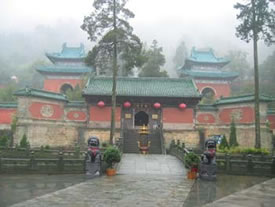
Purple Mountain Taoist Temple
Wu Tang Mountain (Wudangshan) Area
Reference Sources for Translations of the Treatise on T'ai Chi Ch'uan
Olson (2001)
T'ai
Chi According to the I Ching: Embodying the Principles of the Book of Changes.
By Stuart Alve Olson. Rochester, Vermont, Inner Traditions International Ltd., 2001. 224
pages.
ISBN: 0892819448. The T'ai Chi Ch'uan Treatise, attributed to
Ancestor
Chang San-Feng, Sung Dynasty Priest of Wu-Tan Mountain, is found on pp.
36-37. Mr. Olson has many fine books to his credit, and was the longtime friend and
senior student of Master T. T. Liang.
Jou
(1980)
The Tao
of Tai-Chi Chuan: Way to Rejuvenation. By Jou, Tsung
Hwa. Edited by Shoshana
Shapiro. Warwick, New York, Tai Chi Foundation, 1980. 263
pages. First Edition. ISBN: 0804813574. An excellent comprehensive textbook. A Third Edition is now
available.
The Tai-Chi Lun or "The Theory of Tai-Chi Chuan" by Chang Sang-Feng,
pp. 175-180. One
of the first comprehensive books on the subject. Master Jou, I'm sure,
would still be teaching
us if it were not for an tragic automobile accident a few years ago.
Yang (1996)
Tai Chi
Theory and Martial Power: Advanced Yang Style Tai Chi. By Yang,
Jwing-Ming, Ph.D..
Jamaica Plain, Mass., YMAA Publication Center, 1996. First Edition
1987. Second Edition 1996.
Glossary, index,
268 pages. ISBN: 1886969434. Taijiquan
Treatise by Chang, San-Feng, presented at pp. 211-214. Dr. Yang has translated and commented on scores
of Taijiquan and
Qigong treatises and his contributions are outstanding.
Davis (2004)
The
Taijiquan Classics: An Annotated Translation. Translated by Barbara
Davis.
Commentary by Chen, Wei-ming. San Francisco, North Atlantic Books,
2004. 200 pages. ISBN: 1556434316. The Taijiquan Jing, attributed to Zhang
Sanfeng, is presented at pp. 75-76. A first rate contribution in both translation
and commentary.
Liao (1990)
T'ai
Chi Classics. By Waysun Liao. New translations of three
essential texts of T'ai Chi Ch'uan with commentary and practical instruction by Waysun Liao.
Illustrated by the author. Boston, Shambhala, 1990. 210 pages. First Edition, 1977. Second
Edition, 1990. ISBN: 087773531X. The Treatise by Master Chang San-feng (ca. 1200
CE) is presented on pp. 87- 95.
Lo
(1979)
The
Essence of T'ai Chi Ch'uan: The Literary Tradition. Translated and
edited by
Benjamin Pang Jeng Lo; Martin Inn, Robert Amacker, and Susan Foe.
Berkeley,
California, North Atlantic Books, 1979, 1985. 100 pages. ISBN:
0913028630. The T'ai Chi Ch'uan Ching by Chang Sanfeng, pp. 17-27.
Garofalo
(2006)
Chang San-Feng, Taoist
Master. Brief biography, links, bibliography, quotations, and a study
of the "Treatise on Tai Chi Chuan". Compiled by Michael P.
Garofalo. Includes poems and commentary
by Mike Garofalo. Red Bluff, California, Green Way Research,
2006. 117Kb. My version of the "Principles of Taijiquan" is
not a translation but an interpolation, a restatement, a revision, an extension of the meanings implied in the original
terse text. It draws heavily from Taoist alchemical symbolism and other writings
by Taoists
like Master Zhang.
Sifu Wong Kiew Kit
Taijiquan Treatise of Zhang San Feng
Return to the Main Index for this Webpage
|
Tao Te
Ching |
|||||||||
| 1 | 2 | 3 | 4 | 5 | 6 | 7 | 8 | 9 | 10 |
| 11 | 12 | 13 | 14 | 15 | 16 | 17 | 18 | 19 | 20 |
| 21 | 22 | 23 | 24 | 25 | 26 | 27 | 28 | 29 | 30 |
| 31 | 32 | 33 | 34 | 35 | 36 | 37 | 38 | 39 | 40 |
| 41 | 42 | 43 | 44 | 45 | 46 | 47 | 48 | 49 | 50 |
| 51 | 52 | 53 | 54 | 55 | 56 | 57 | 58 | 59 | 60 |
| 61 | 62 | 63 | 64 | 65 | 66 | 67 | 68 | 69 | 70 |
| 71 | 72 | 73 | 74 | 75 | 76 | 77 | 78 | 79 | 80 |
| 81 | |||||||||
The Writings Attributed to Master Zhang San Feng
Nobody really knows whether or not one of the numerous persons called "Master Zhang San Feng" actually wrote these short treatises or commentaries attributed to him. They may have been documents compiled, redacted, edited, or composed by persons associated with a Taoist school where Master Zhang San Feng is respected or revered. They may have been compiled or written hundreds of years after Master Zhang San Feng died or disappeared. This is also true for writings attributed to Lao Tzu. The official Taoist cannon consists of thousands of documents composed over many centuries since 500 BCE. The documents are part of the extensive Taoist written tradition, and the exact author of a particular document is sometimes uncertain.
Writings on the Tao by Master Chang Sanfeng This extensive collection of documents claims to be based on the excellent work by Thomas Cleary, Vitality, Energy, Spirit: A Taoist Sourcebook, 1991. I don't think Mr. Cleary attributed so many texts to Chang Sanfeng.
Treatise on
Tai Chi
The Principles of T'ai Chi Ch'uan
Attributed to the Taoist Master Chang San-Feng
A very popular "classic" treatise amongst Taijiquan enthusiasts. Many
commentaries exist for this Treatise on Tai Chi.
Focusing Spirit Accumulating Energy Treatise in Grand Ultimate Practice
"The beginning of Grand Ultimate is Limitless Void. Nebulous as one energy. No
separation. Thus, Limitless Void is the mother of Grand Ultimate. Thus the
origin of myriad of things.
Two energies separate. Heaven and earth judge. Grand
Ultimate results. Two energies are yin and yang. Yin quiescent and yang dynamic.
Yin terminates yang generates.
Heaven and earth are separated into pure and impure.
Pure floats impure sinks. Pure high impure low. Yin and yang combine, pure and
impure unite. Interact and generate, result in myriad things.
Life of man originally possesses Limitless Void. This is
the prenatal mechanics. Creation of man is post-natal, thus Grand Ultimate. Thus
myriad things not without Limitless Void. Also not without Grand Ultimate.
The function of man. When there is movement, there must
be quiescence. Extreme quiescence there must be movement. Movement and
quiescence mutually operate, that is yin-yang. United become one Grand Ultimate.
Life of man is all dependent on spirit and energy. Pure
energy rises up. Doubtless to heaven. Focus spirit internally. Doubtless to
earth. Spirit and energy unit. Result in one Grand Ultimate.
Hence, the transmission of my Art of Grand Ultimate.
First, understand the marvelous way of the Grand Ultimate. Not understand this,
not my students.
Art of Grand Ultimate, movement is like quiescence.
Quiescence is like movement. Movement and quiescence interact. Mutually
connected without break. Two energies unite. Signals the attainment of the Grand
Ultimate. Internally focus spirit. Externally accumulate energy. Before form
arrives, intention first arrives. Form has not arrived, intention has already
arrived. What is intention? The agent of spirit.
Spirit and energy unite, the seat of Grand Ultimate is
decided. Its sign is settled. Its seat is settled. Continuously interact. The
number seventy two. Thirteen techniques in Art of Grand Ultimate. Ward off, roll
back, press in, in contact, take, spread, elbow, anchor. Forward, backward, to
the left, to the right, remain at center. According to creation and reaction of
Eight Symbols and Five Processes.
Also empty spirit, ignore pull, loosen waist, settle
false-real, sink and press, use intention and not use strength. Top and bottom
coordinated, internal and external united. Continuously linked without break.
Quiescence found in movement. The ten essentials in Art of Grand Ultimate.
No-two-gate for those who learn the art. Fundamental for entering the way.
Entering the way nourish heart stabilize nature;
accumulate energy focus spirit be main path. Practice this art must follow thus.
Heart not peaceful, nature disturbed. Energy not accumulated, spirit disordered.
Heart and nature not united, spirit and energy not
coordinated, four limbs and hundred meridians of body lifeless, and functions
useless. To pacify heart and stabilize nature, focus spirit and accumulate
energy. Not miss hit-sitting. Not neglect techniques of training. Search within
movement and quiescence the benefits of Grand Ultimate.
From Eight Symbols and Five Processes find principles of
creation and reaction. Use seventy two number to achieve heart and nature,
spirit and energy of the Grand Ultimate. Mutually function. Thus heart peaceful
nature stabilized, spirit focused energy accumulated. Achieve attainment of
Grand Ultimate in body. Yin-yang unite, movement and quiescence become one. Four
limbs and hundred meridians of body flow smoothly. Without stagnation without
wastage. Hence receive my transmission."
-
Focusing Spirit Accumulating Energy Treatise in Grand Ultimate Practice
Attributed to Master Zhang San Feng
A literal translation by Grandmaster Wong Kiew Kit, 2012,
at Flowing Zen
Speaking of the Dao in Plain Words
Attributed to Zhang Sang-feng
Translated by Li Siming, 2011
Sections 1-17, Chinese characters and English translation
Those pursuing the Dao, need to know the three stages
and three gates.
To sum up in four sentences: “after non-doing, follow by doing; after doing,
back to non-doing”. (Section 1)
In Internal Alchemy there are also three stages,
accumulating the essence and chi is the first stage, opening and closing
passages is the second stage, building the foundation and refine the self is the
third stage.
Begin with the first stage, is basically to purify the mind and to abstain from
desire, first close the external three treasures (ear, eye, mouth), and nurture
the internal three treasures (essence, chi, spirit). (Section 2)
The “I-Ching” said, “Explore and understand the truth
and the source of life, and then to life”, this describes stages of Daoist
cultivation.
What is exploring the truth?
Read the authentic teachings, explore the authentic pathways, observe the
transformation of the universe, explore the Horse Diagram and the Turtle
Diagram, retain the chi during leisure times, keep the spirit (from scattering)
to build the foundation.
Explore the truth together with the source of life, and you will get the
unbeatable body, and to pursue the medicine to last forever.
The source of life means internal, life means external, connect the internal to
the external as one, and arrive at the great Dao.
The three words “and then to” describes the process of returning to innate life
from the acquired life, there is no need to look for further formula within.
(Section 3)
Condense the spirit, means collecting one’s purified
mind to enter into the inside.
When the mind is not yet purified, don’t close the eyes, first encourage the
mind to come back, be cool and indifferent, then bring the mind to the energy
center, this is called condensing the spirit.
When the spirit is condensed, it is like sitting on top of a tall mountain and
looking at the mountains and waters, like putting up a sky lamp lighting up
every darkness and obscurity, this is the meaning of condensing the spirit on
emptiness.
Regulating the breath is not difficult, when the mind-spirit is quiet, following
the breath naturally, I only abide in the naturalness, this when combined with
spirit lighting downward, is what means by regulating the breath.
Regulating the breath, means mixing Yin Qiao Chi with mind’s chi in chi center.
Condensing the mind under the naval is called condensing the spirit, returning
the chi under the naval is called regulating the breath.
When spirit leans with breath, abide in natural cleanliness is called “not
forgetting”, allow for natural cleanliness is called “not assisting”.
Not forgetting and not assisting use silence and softness, breath is active and
mind at ease.
See nothingness as the place to keep the mind, see dim silence as home for
breath and spirit, again and again, purify and purify, all of a sudden spirit
and breathe both forgotten, spirit and energy fused.
The Yang suddenly arise like one is drunk.
True appearing and disappearing, happens when the mystical gate is realized.
In scriptures what named as “innate”, “real”, “original” arise from the Yin-Yang
furnace, from the dark-unconscious-silence, like one appear from obscurity, you
can use this to read Internal Alchemy scriptures. (Section 4)
Dao is difficult to learn, and so is teaching the Dao.
The teacher is diligent, are the student lazy?
The teacher can bear the trouble, can the student endure?
Learn not thoroughly, practice not diligently, and mind is not pure, spirit is
not real, if approach the Dao with these, not one in ten-thousand succeed.
Confucius said “To know this mechanism, is via the spirit”.
He did not say via one’s intention, but via the spirit, we can see this subtle
appearing and disappearing can only be known via the spirit.
Now classify this as “mechanism moves slightly, the straight-forward is
straight.
To know the mechanism, one can never succeed via the mind, intent, and thought.
This is mystical!
Spirit need to be the real spirit, to be called innate.
Real spirit is, real thought, real mind, real intent. How to differentiate?
Teachings said: “fire started in the mystical gate, awake the obscure darkness,
the consciousness is it.
Alchemist said: “one thought arise from completeness”, is real spirit, the real
mind.
Other said: “In mist, light of the mind is found”, is real spirit, the real
intent.
Other said: “In stillness arise wisdom, one’s intent circulates”, is real
spirit, real intent.
Real spirit never arise from refining the spirit, student should know this.
(Section 5)
The Great Dao can be entered via the word “Center”, what
is called “Center”, one is of the body, one is not of the body (non-body).
Kungfu should be proceed in two levels.
First, find the center of the body, Zhuzi said “Abide in the center when
handling the external.”
To abide in the center, one need to bring back the (spirit) light to inside, pay
attention to the center, 1.3 inches below the belly button, keep the attention,
this is the finding the center of the body.
Second, find the non-body center, Confucius’ said: “Center is prior to the
uprising of happy, angry, sad, joy”, at this moment, there is no hearing and no
seeing, thieves are cautious, hidden and alone, and naturally the nature becomes
still and the spirit becomes clear, spirit becomes clear and energy becomes
pure, to here one starts to see one’s original face, this seeking is not within
the body.
Use the center of the body, to pursue the center not of the body, and desire
will become easy to purify, heaven’s nature will return to order, saints
immortals and buddhas throughout the history, had used this as the first step
practice.
During meditation, the most important is to condense the spirit and regulate the
breath, use calmness to bring back order, refrain from assisting and forgetting,
none will not gain kungfu by day.
Condensing the spirit and regulating the breath, only need flat mind and
harmonized energy.
When mind is flatten spirit is condensed, when energy is harmonized breath is
regulated.
The word “flatten” is wonderful, when no wave arise in the mind it is flatten,
mind abide in it is called flat, flat is in the center.
When the mind is in it, there is no wave.
Ancient immortal said: “Regulate the real breath, refine the non-spirit spirit.”
Real breath is the breath when the breath stops; non-spirit spirit is the spirit
of the spirit.
To sum up one need to empty the human mind, embrace the Dao mind, return this
Dao mind back to emptiness, dark and silence, save in the center, and one can
nurture the real breath, obtain the non-spirit spirit. (Section 10)"
-
Speaking of the Dao in Plain Words, Attributed
to Zhang San-Feng,
Translated by Li Siming, 2011. Sections 1-17 translated, Chinese
characters and English translation
Return to the Main Index for this Webpage
Commentary on Ancestor
Lu's
Hundred-Character Tablet
Attributed to the Taoist Master Chang San-Feng
"Nuturing energy, forget words and guard it.
Conquer the mind, do nondoing.
In activity and quietude, know the source progenitor.
There is no thing; whom else do you seek?
Real constancy should respond to people;
In responding to people, it is essential not to get confused.
When you don't get confused, your nature is naturally stable;
When your nature is stable, energy naturally returns.
When energy returns, Elixir spontaneously crystallizes,
In the pot pairing water and fire.
Yin and yang arise, alternating over and over again,
Everywhere producing the sound of thunder.
White clouds assemble on the summit,
Sweet dew bathes the polar mountain.
Having drunk the wine of longevity,
You wander free; who can know you?
You sit and listen to the stringless tune,
You clearly understand the mechanism of creation.
The whole of these twenty verses
is a ladder straight to heaven."
- Thomas Cleary, Vitality, Energy, Spirit: A Taoist Sourcebook. Translated and edited by Thomas Cleary. Boston, Shambhala, 1991. 281 pages. ISBN: 0877735190. p. 185
"Breathing Out -
Touching the Root of Heaven,
One's heart opens;
The Dragon slips by like water..
Breathing In -
Standing on the Root of Earth,
One's heart is still and deep;
The Tiger's claw cannot be moved.
As you go on breathing in this frame of mind, with these associations,
alternating
between movement and stillness, it is important that the focus of your mind does
not shift. Let the true breath come and go, a subtle continuum on the
brink
of existence. Tune the breathing until you get breath without breathing;
become
one with it, and then the spirit can be solidified and the elixir can be
made."
- Chang San-Feng, Commentary on Ancestor Lu's Hundred-Character
Tablet
Translated by Thomas Cleary, Vitality,
Energy, Spirit: A Taoist Sourcebook, 1991, p. 187.
Poetic interpretation by Mike Garofalo of expository text of
Chang San-Feng.
The Rootless
Tree
無根樹 Wugen Shu
Attributed to the Taoist Master Zhang San Feng
Rootless Tree
By Zhang Sanfeng
Translated by Akrisi
24 Verses with Commentary and Footnotes
Rootless tree, the flower is shattered,
Cling to vanity - who will cease?
Wretched life, a sea of sufferings,
Drifting here and there is not free.
No shore nor end, no berth to park,
All day sail around sharks and fishes.
If you repent, there is the shore,
Not till the wind and waves break your vessel. (Ver.1)
Rootless tree, the
flower is withering,
Renew old tree and graft green branch.
Plum on willow, mulberry with pear,
Pass to devotees as an example.
Ancient method of transplanting immortals,
There is really a cure to aging.
Seek a Master, ask for the recipe,
Proceed to practice before it's too late. (Ver.2)
Rootless tree, the
flower is deviated,
Part from
Yin Yang
Tao not full.
Metal from wood, mercury from lead,
Yin Yang each at one side, like orphan and widow.
Yin Yang on earth is like man and his mate,
Sons and grandsons, successive generations.
Comply and be earthen, regress to be
immortal,
Only in between top down top. (Ver.5)
Rootless tree, flower
is numerous,
Sweet and charming surpass cosmetics.
Beware the restless mind, and the heart full of whims,
Wear an iron face like your mother.
Draw the real sword of the azure dragon,
And pluck the fresh flowers off the walls.
Avail of the wind, and pull a full sail,
Through the treasure mountain how empty-handed? (Ver.7)
Rootless tree, the
flower is blooming,
Pick the flower from the crescent moon pot.
Prolong life, cure ailment and mishap,
So as to equip theurgic treasures for your friends.
From this can accomplish heavenly treasure,
Never mind the refuters mock me a fool.
Advice to the talented, don't show off your wit,
Not meet a Master, don't try hard to guess. (Ver. 9)
Rootless tree, the
flower is charming,
On earth react to tides but to stars from the sky.
Dragon slaying sword, and tiger tying rope,
Revolve the ladle handle of the pole star.
Smelt a pot of real sun and moon,
Sweep away all other three thousand heresies.
Walk on top of the sky, how carefree,
Sins and mortal filths wipe out in one stroke. (Ver.17)
Rootless tree, the
flower in pair,
Dragon tiger appear and fight on the scene.
Lead
casted into mercury, Yin
concoct with
Yang,
Theurgical form of
millet
pearl is
worth priceless.
This is
the real seed of homestead,
Turn old man to boy and long live.
Ascend to heaven, way to pure bliss,
Refrain from rebirth not to meet king of hell. (Ver.19)
Rootless tree, the
flower is rare,
Grow it in the moon for a moment.
Cloud grabbing hands, walk on ladders of clouds,
Fetch the pre-heavenly first flower.
Drink wine enjoy flower feeling so well,
So much fun to immortal elders with me dead-drunk.
Entrust to the heart, carefully safeguard,
For fear that fire surge up and down in the pot. (Ver.20)
Rootless tree, the
flower is red,
Pick all the red flowers now empty tree.
Form is empty, emptiness is the form,
Thoroughly discern that emptiness is in forms.
Know clearly emptiness then forms will perish,
but theurgical form long last not come to naught.
Called
perfectly penetrating, the Great Hero of Truth,
All ancestors ascend to Nine Skies. (Ver. 23)
- Rootless Tree, Attributed to Zhang Sanfeng, Translated by Akrisi, 24 Verses with Commentary and Footnotes
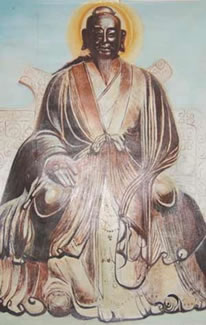
Song of Silent Sitting
Attributed to the Taoist Master Chang San-Feng
"Sitting silently, practice meditation;
The impulse is at yuanguan.
Continuously and gently regulate your breathing;
One yin and one yang brewing in the internal cauldron.
Nature must be enlightened, life be preserved.
Don't rush, let the fire burn slowly.
Close your eyes and look at your heart of life.
Let tranquility and spontaneity be the source.
In a hundred days you will see a result:
A drop of elixir rises from kan,
The Yellow woman is the matchmaker in between,
Both the baby and the red lady are perfect.
The beauty is boundless and inexplicable,
All over the body vital energy arises.
Who can know such a marvelous experience?
It's like a dumb person having a beautiful dream.
Swiftly take in the primordial essence;
The elixir breaks through the three obstacles,
Rising from dantian to the top at niyuan,
Then submerging into the zongyuan.
Water and fire combine for form real mercury,
Without wu and ji there is no elixir.
Let the mind be still, and life be strong.
The spirit radiates throughout 3,000 worlds.
Golden cockerel crows beneath the shadowless tree,
The red lotus blossoms in the middle of night.
Winter comes the sun shines again,
A thunderous roar shatters heaven and earth.
Dragons call, tigers play,
Heavenly music fills the sky with harmony.
In nebulous mixture everything is empty,
The infinite phenomena are all here.
Marvelous in its mystery, mysterious in its marvel.
The circulation of the stream breaks through the three obstacles;
All phenomena are born in the union of heaven and earth.
Drink the dew of nature, sweet like honey,
Saints are buddhas, buddhas are saints.
When the ultimate reality reveals dualism disappears,
Now I realize all religions are the same!
Eat when hungry, sleep when tired,
Offer a joss stick and practice meditation.
The great Tao is just before your eyes,
If you are deluded, you'll miss the chance.
Once you've lost your human form you may have to wait a million eons.
The uninformed dream of going to heaven,
The blind go into a deep forest to practice.
The ultimate secret is marvelous beyond the profane,
Letting out the ultimate secret is heavy sin.
The four true principles you have to cultivate,
Breaking the gate of mystery to reach the marvelous.
Cultivate day and nigh without break,
Get a master early to develop your elixir.
There are people who know that real mercury
Is the elixir of longevity and immortality.
Cultivate each day, be more determined each day;
Do not regard spiritual cultivation as just an ad hoc task.
To succeed one must cultivate for three years, nine years,
Before a pearl of elixir can be cultivated.
If you want to know who composed this song,
It's by the Taoist Priest of Purity and Void, the Saint Zhang San Feng."
- Master Chang San-Feng, Song of Silent Sitting, from the "The Secret of Training in the Internal Elixir in the Tai Chi Art." Sources: Wong Kiew Kit, The Complete Book of Tai Chi Chuan, 1996, pp.19-21. Zhang San Feng, The Secret of Training the Internal Elixir in the Tai Chi Art, preserved by Taiyi Shanren, reprinted from an ancient text by Anhua Publications, Hong Kong, undated, pp. 68-69, in Chinese. Translated by Wong Kiew Kit, 1996.
Taoist Grand Master Chang San-Feng
The Tao
of Tai-Chi Chuan: Way to Rejuvenation (1980) by Master Jou, Tsung Hwa
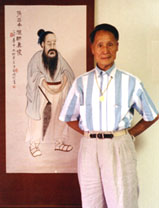
Master Jou, Tzung Hwa
Renowned for his fitness and intelligence.
Return to the Main Index for this Webpage
Meetings with Master Chang San-Feng
Poetic Reflections by Michael P. Garofalo
"I first met Chang San-Feng above the forest,
near the clear spring,
when gathering clouds darkened the day,
and Mt. Shasta was silent.
His long beard was black as emptiness,
ear lobes to his shoulders,
holding obsidian in his hand,
pointing to the sun,
eyes staring into infinity,
his long body clothed in silence.
We exchanged "hellos"
smiled and bowed,
a barbarian and an Immortal,
both panting from the climb,
laughing,
ten-thousand echoes
between our rocky minds.
After billions upon billions of heartbeats past
(for he must have been 888 years old),
I was so bold
as to ask the ancient one
for the sacred mantra of yore.
He lifted his whisk,
and brushed my face,
I could not speak,
my lips were stone,
ideas stopped -
I was alone."
- Michael P. Garofalo
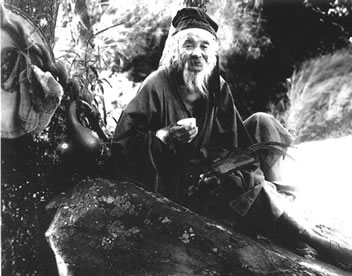

"After reaching for the needle at the bottom of the sea,
I looked up, one summer's eve,
to see old Chang
San-Feng open the garden gate,
and join me for Tai Chi.
We said not a word -
hands moving like clouds,
fingers grasping sparrow's tails,
faces smiling, feeling the sun drop,
glimpsing a half moon climbing the clear sky.
Time flowed without
a ripple of memories,
Space embraced a crane cooling its wings,
Being began to sing
softly in tune with the moon.
My dusty black dog
barked,
sensing something on the warm wind;
speaking her mind,
ears up.
Master Chang was gone.
Leaving one shoe on a beanpole, and
a page of poems -
mementos for mortals.
Two black
butterflies
danced wing to wing
in love."
- Michael P. Garofalo
"Standing at the Mysterious Pass
Centered in the Eternal Now,
Balanced in Body and Open in Mind,
Rooted into the Sacred Space,
Motionless as the Golden Mountain,
Fingers around the Primeval Sphere.
Dragons and Tigers are still dreaming -
Ready for Rebirth.
I breathe in, the World Breathes Out.
The Gate of Space opens;
Heaven moves and Yang is born.
The hands move out, embracing the One.
The mind settles and is clear.
The Dragon Howls,
Ravens fill the Vast Cauldron,
Mind forms melt like mercury,
Spirit rises in the Clouds of Eternity.
Yin appears like the moon at dusk.
I breathe out, the World Breathes In.
The Doors of Emptiness close;
Earth quiets and Yin is born.
The hands move in, entering the One.
The body settles and becomes whole.
The Tiger Roars,
The Great Ox is nourished by the Valley Spirit,
Substances spark from flaming furnaces,
Essence roots in the Watery Flesh.
Yang appears like the sun at dawn.
Dragons and Tigers
Transformed within the Mysterious Pass -
Chanting and Purring.
Awakened,
Peaceful,
Free."
- Michael P. Garofalo, Opening
at the Mysterious Pass
Opening Hands (Kai Shou) and Closing Hands (He Shou) Qigong
Sun Lu Tang’s Style of
Taijiquan. Master Sun Lu Tang
studied Taoism and Internal Mind-Body Arts at various Wu Tang Mountain Temples in 1895.
"Standing still in the circle of trees, in the
sacred space,
one wet and chilly morn,
feet rooted, turtle toes clawing the earth, sunk deeply down;
twisted like a dragon, alert, poised, ready to fly;
settled like a bear, strong, full of power, gathering;
looking through the tiger's eye, mind-intent, penetrating;
embracing the World of Body, Mind, and Spirit,
as ancient as Now, the Three Realms, all still, all one.
From the edge, the cosmic circle opened,
Chang San-Feng slipped inside, smiling,
he stroked his long black beard and spoke softly,
"Ah, another old man standing so still in San Ti Shi.
Continue, my friend, stand in peace, touch the mind.
Xuan Wu guards the Gate, the Turtle chants, the Snake rises, and
The subtle winds of understanding blow down the centuries.
When still, soar like the Black Dragon; when moving, walk like the Mountain.
Tame the Tiger within, ride the Tiger to the temple, and roar in
silence.
Awaken like the Bear from the winter of the soul, and rise like a Man.
Feel the vital energies from
bone to brain,
Sense the Great Tao before you Now,
Drop delusions, enter the Gate of Mystery,
Embrace the Center, Empty, unattached, ready to be filled
With boundless beauty, everything There, marvelous beyond words."
The cottonwood leaves spoke with the wind,
the sun rose over the shadows,
my legs shook a little;
the cosmic circle trembled,
Xuan Wu's sword flashed in the sun,
Master Chang disappeared in the trees."
- Michael P. Garofalo
Xuan Wu Dadi, Dark Lord of the North
Union of the Three Realms: San Ti Shi
Master Chang's Pepper Talk
“Do not neglect fasting the mind,
and, for you, fasting the flesh,
until you are as fast as the Tameless White Tiger,
lean as Xuan Wu’s Snake General,
still and strong as the Black Tortoise,
and worthy of Lao Tzu’s wisdom.”
"I saw Master Chang San-Feng
Enter the Sidhe, Fairies by his side,
Crossing over the pond at dawn.
Astonished I was!
On the teahouse table by the pond I later found
Some of his neatly printed notes
Folded in a well worn tome
Of the Tao Te Ching, in Chapter 14.
He had written:
”Even for an Immortal, the Past is the Key.
The Future
Grasp at it, but you can’t get it,
Colorless as an invisible crystal web,
Unformed, thin, a conundrum of ideas,
The Grand White Cloud Temple of Possibilities,
Flimsy as a maybe, strong as our hopes,
Silent as eternal Space.
When you meet it, you can’t see its face.
You want to stand for it, but cannot find a place.
The Present
It appears and disappears through the moving ten thousand things,
Quick as a wink, elusive as a hummingbird,
Always Now with no other choice,
Moving ground, unstable Plates,
Real as much as Real gets to Be,
This Day has finally come,
Room for something, for the moment, waits
Gone in a flash, assigned a date,
Gulp, swallowed by the future.
Unceasing, continuous, entering and leaving
The vast empty center of the Elixir Field.
The Past
Becoming obscurer, fading, falling apart,
A mess of memories in the matrix of brains;
Some of it written, fixed in ink, chiseled in stone,
Most of it long lost in graves of pure grey bones.
Following it you cannot see its back,
Only forms of the formless, stories, tales,
Images of imageless, fictions, myths.
A smattering of forever fixed facts,
Scattered about the homes of fading ghosts.
The twists and turns of millions of tongues
Leaving us languages, our passports to the past.
The future becomes
past, the present becomes past,
Every thing lives, subtracting but seconds for Nowness, in the Past.
The Realms of the Gods, the kingdoms of men,
The Evolutionary Tree with roots a million years long
Intertwined with turtles, dragons, trees, stars and toads;
crickets, coyotes, grasses, tigers, bears, monkeys and men.
These profoundest
Three of Time
An unraveled red Knot of Mystery,
Evading scrutiny in the darkness of days
Eluding capture in the brightness of nights,
In beginnings and endings are only One, the Tao,
Coming from Nowhere, Returning to Nothing.
What dimension of
Time
Does your mind dwell within?
Future, Present or Past
Where is your homeland?
The Past holds the
accomplishments, the created, the glories, and the Great.
The Present is but a thin coat of ice on the Pond of Fate.
The Future is an illusion, a guess, a plethora of possible states.
Recreate the Past
By playing within the Present.
Twisting and reeling one’s silky reality
From the Black Cocoons of the Acts
From which we create our Pasts.
Follow the Ancient Ways.
The Past is the Key.”
- Michael P. Garofalo, September 2011
The Decaying Tree
"The smell of the sea hugged the fog in the redwood
trees,
All cool and dank, dimly lit and rank with green,
And in shadowed limbs the Stellar jays jabbered free,
And me, standing silently, an alien in this enchanted scene.
From behind the mossy grey stumps
the sounds of footsteps crunching fronds of ferns
caught my suddenly wary mind ...
What?
"Hello, old friend," said Chang San Feng.
"Master Chang, what a surprise," said I.
Master Chang sat on a stump, smiled, and said,
"Can you hear the Blue Dragon singing in the decaying
tree;
Or is it the White Tiger roaring in the wilderness of your bright white skull?
No matter! The answer is in the questioning; don't you Chan men see?
In the red ball flesh of this decaying tree
Sapless woody shards of centuries of seasons
Nourish the new roots of mindfulness sprouting.
Yes, Yes, but how can it be?
The up-surging waves of life sprout forth from the decaying tree,
As sure as sunrise rolling over the deep black sea.
Coming, coming, endlessly coming; waves of Chi.
Tan Qian's raven roosts for 10,000 moons
in the withered branches of the rotting tree;
then, one day, the weathered tree falls,
nobody hearing, soundlessly crashing
on the forest floor, on some unknown noon.
Over and over, over and over, life bringing death, death
bringing life,
Beyond even the miraculous memories of an old Xian like me;
Watching, watching, sequestered from the strife,
Turning my soul away sometimes because I cannot bear to see.
Even minds may die, but Mind is always free
Bounding beyond, beyond, far beyond you and me;
Somehow finding the Possibility Keys
And unlocking the Door out of the Voids of Eternities."
Master Chang somehow, someway,
slowly disappeared into the red brown heart of the decaying tree.
Then the squawk of the jay
opened my mind's eye to the new day -
Namaste."
- Michael P. Garofalo
Remembering Prairie Creek Redwoods State Park, California
April 27, 2012
Comings and Goings Around Mt. Adams (Pahto)
I met a sturdy young man, Frank, at a campground along
the Klickitat River,
far below
Mt. Adams. We talked for a good while at sunset.
He told me that he had met a fine fellow, a Mr. Chang San-Feng,
in the forest below Old Pahto; who had published a book of
poems and short essays. I later found a copy of that book
at Klindt's Bookstore in The Dalles. Here is one poem
from the book by Mr. Chang San-Feng:
"Ancient Mt. Adams glows in the last light,
winds whistling in the thick flowing firs.
Slithering snakes in the cracks of warm
lava beds. Dry skies: empty vastness.
A dusty camp near shallow Trout Lake, all
cooling in the darkening shadows.
Stellar Jays check my table
for crumbs. Nothing there to eat.
Both Presence and Absence wrapped
in Becoming. Just sit─ a mirror in the dim dusk.
Long stretches of not thinking just
listening. The mountains are speechless.
Turning on a flashlight reveals the tent's
thin armor. The beam pierces the walls.
The Tao unfolds itself─ moon rising
midnight. Sleeping away losses and fears.
Coyotes calling at first hour hunting
hungry. The hard ground gets colder.
The Yakima's named It "Pahto or Klickitat"
many
centuries past. Thus It became something human,
Something Pointed Out, Something Named,
Something Talked About, slipping away from Presence.
Some man loudly snoring and a dog barks in a nearby tent
at second hour. My watch does not really embrace Time.
At third hour I awaken, sit up, nurturing
my liver. I smile, alone, in passing Darkness,
without Her but within Her,
the Valley Spirit Here and Now.
At fourth hour, Buddha-Mountains disintegrate, and
slowly
drying racoon Buddha-Crap shrivels on Buddha-Poppy seeds.
In the distance, somewhere, out there,
Rising, rising into the black clouds, just-so,
Making Clouds Itself, As Is, and in no-mind,
the Transforming Pahto.
I suddenly remembered something
Sifu Miao Zhang
once told me:
"Master Yellow-Bitterroot Mountain asked me,
'What is the meaning of Old Pahto emerging in the West?'
I lifted my cane and placed it in my mouth, saying nothing.
Later, zany Zen liar that I am, I wrote:
"No minds, no dharmas. No-mind, much Dharma."
Daybreak crawls in earlier in June, Solstice
Coming, Growing more Sunbeams, Ch'i
Flowing over Everything awakening.
Dawn, we are the Light, everything appearing
pristine, startling, sudden brief jolt of Insight.
After the Awakening,
roll up the sleeping bag, take down the tent,
eat some cereal."
- Michael P. Garofalo
Return to the Main Index for this Webpage

Red Bluff, Tehama County, North Sacramento Valley, Northern California, U.S.A.
Cities in the area: Oroville, Paradise, Durham, Chico, Hamilton City, Orland,
Corning,
Rancho Tehama, Los Molinos, Tehama, Proberta, Gerber, Manton, Cottonwood,
Anderson, Shasta Lake, Palo Cedro, and Redding, CA
Vancouver, Washington, 2017-2020
Cloud Hands Blog of
Michael P. Garofalo

Facebook of
Michael P. Garofalo

Return to
the Alphabetical Index of Mike Garofalo's Hypertext Documents
© Michael P. Garofalo, 2003-2021, All Rights Reserved
Valley Spirit
Center, Fir Grove, Vancouver, Washington, 2020-
Cloud Hands Website: T'ai Chi Ch'uan and Chi Kung
This webpage was first published on the Internet in January of 2003.
This webpage was last edited, changed, expanded, modified or updated on April 6, 2021.
|
Tao Te Ching by Lao Tzu
For each of
the 81 Chapters: Daodejing 81 Website |
|
||||||||||||||||||||||||||||||||||||||||||||||||||||||||||||||||||||||||||||||||||||||||||||||||||||