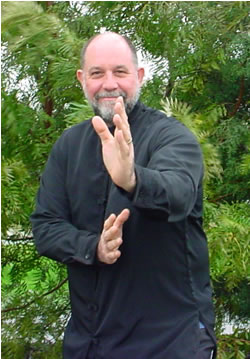
Mike Garofalo in 2010 in Red Bluff, CA.
Learning the Chen Style of
Taijiquan
Relearning the
Chen 18 Taijiquan Form in 2022
Learning the Old Frame, First Form, Lao Jia Yi Lu of Chen Taijiquan in 2022-2023
Notes, Journal, Suggestions, Comments, Research, Progress Reports, Studies, Plans
Cloud Hands Blog Chen Blog Posts Chen Style of Taijiquan Forms Taijiquan Qigong
Silk Reeling Chen 18 Form Chen 74 Form Laojia Yilu Chen 23 Broadsword
Breathing Fundamental Principles Train the Body Not the Techniques
Journal of
Michael P. Garofalo - Case Study - Learning the Chen First Form - Weekly
Notes
Week One, Week Two, Week Three, Week Four, Week Five
Mike Garofalo in 2010 in Red Bluff, CA.
1. Beginning to Learn the Chen Taijiquan Lao Jia Yi Lu, First Form, in 2022-2023
I began this new Chen Taijquan First Form learning project on September 1, 2022, when I was 76 years of age.
I walk for an hour each day, do many household and gardening chores, read
extensively, write frequently, honor family and social commitments, travel only in the Northwest,
and practice the Yang 108 and Yang 24 Taijiquan as a solo practitioner. I
retired in 2017 after working till I was 70 years of age. I am in fair physical health in 2022 for an old man with no joint or limb problems or
any surgeries (yet - luck willing) for knees or hips. I do have arthritis
in my right shoulder that has damaged the cartridge, but the daily pain is minor
and the range of motion still fairly good. I don't lift any heavy weights like
I did from 1998-2017. I do have heart disease and problems resulting.
I realize that I will need some additional extra conditioning, strength training, stretching, limbering, etc., to make steady progress in learning the Chen Taijiquan First Form.
The first four movements of the Laojia Yilu (First Form) are the same as the he first 4 movements of the Chen 18, so my start is easier than other beginners since I learned that short form around 2010. The Buddha's Warrior Attendant is both expressive and complicated.
2. Learning Resources, Strategies and Tactics for Learning
a) I learned the
Chen Taijiquan 18
Form of Grand Master Chen Zheng Lei in 2010.
b) I practice various versions of Silk Reeling exercises, qigong, stretching, dumbbell lifting, and walking.
c) In September of 2022, I began my
serious study and daily practice of the Chen
Taijiquan Old Frame, First Form, Lao Jia Yi Lu. Really getting
comfortable with the practice of the entire form up to movement 30, and gaining a basic
understanding of this traditional form is my main learning objective for 2022.
I use many books and, most important, instructional DVDs in this order:
1. Chen Tai Chi Laojia Yilu. By Sifu Ken Gullette. 5 hours, 2 DVDs.
2. Chen Style Tai Chi Old Frame Routine One. By Master Jesse Tsao. 2 hours, 2 DVDs.
3. Traditional Chen Village, Chen Style Tai Chi, Lao Jia Yi Lou. By Shifu Jiang Jian-ye. 4 hours, 2 DVDs.
4. Traditional Hand and Sword. By Ren Guangyi, 230 pages, 2007. 1,300 Photographs of this Form.
You will need to purchase a decent portable DVD player for under $50 US. I use a Electcom Pro portable DVD player. The 3 DVDs listed above and a DVD player will cost you well under $200 US in 2022 - all one time purchases to get you going on learning this form.
d) Lists of Movements of Chen First Form
List of Movements, Movements 1-74, Chen Taijiquan, 1840, Old Frame, First Form. A 2 page document in PDF Printable Format
Section 1,
Movements 1 - 10, List of Movements, PDF format
Section 2, Movements 20 - 30, List of Movements,
PDF format
Section 3, Movements 30 - 40, List of Movements,
PDF format
Section 4, Movements 40 - 50, List of Movements,
PDF format
Section 5, Movements 50 - 60, List of Movements,
PDF format
Section 6, Movements 60 - 74, List of Movements,
PDF format
e) Learning Tactics:
I usually begin by watching Jesse Tsao teach the Chen Taijquan First Form. He is far less detailed in explanations compared with Gullette or Jiang. This gives me a basic idea of the next movement I am learning in terms of leg and arm movements, angles and directions, waist and groin/gua turning, issuing force, ending posture, bearing, etc. I try to learn the specific named movement in a general way. Then, afterwards, I view Gullette and Jiang for more detailed and complete explanations and insights into each movement.
I keep a spiral bound notebook for making notes, keeping lists of movements, cue words, uplifting quotes, observations, suggestions, etc. I keep this in the area I am practicing for reference. Some of these notes I transfer to this Learning Journal.
I practice at my home. Indoors, I have a clear space that is 30 feet x 7 feet. I sometimes need to modify angles of movements to fit into my indoor space. I also have to modify my practice of the Yang Style of Taijiquan to fit my indoor workout space. I most often practice indoors when outdoor temperatures are below 50-60F.
I am a big man, 6'6" and 232 pounds. Therefore, my indoor form practice is more compact and modified to suit the space.
Outdoors, my form is more open, wider, and longer, and BIG Frame. My outdoor form is closer to modeling my Chen DVD teacher. Some benefits of all Taijiquan training are a greater appreciation and awareness for the space around you, avoiding bumping into other objects or persons, avoiding falls, and avoiding dangers in your environment. Adjusting my form to indoor space limitations causes me to be more compact, more careful, turn differently, and avoid obstacles.
Outdoors, I have a large back concrete porch to practice on, as well as plenty of lawn or dirt open areas on our property for practice in pleasant weather over 50-60F when it is not raining. Vancouver, Washington, where I live, has generally mild weather, not too cold in the winter or not hot in the summer.
I practice Taijiquan alone at home
for a variety of
good reasons. I am
open to studying and learning the Chen First Form with other persons for
free at my home in 2022-2023. I have offered to help form a Chen Style Taijiquan Study and Sharing Group in Vancouver, Washington, starting in October of 2022. I sent out email invitations and made a Blog post to ask people to learn with this support group.
"If one is persistent and practices every day, proficiency in the form will be achievable within half a year." - Davidine Siaw-Voon Sim
d) Moderation, Limitations, Restraints, Simplicity
Don't overdue exercising and working, don't exercise to excess, quit working when you are tired. Always leave something in your tank, or put less on your plate. 70% is just fine, both in eating and exercising. You don't want to do extreme training like Bruce Lee did; don't overwork yourself. If your over 40, be very careful about over-training. I have read many Taijiquan teachers talk about how demanding and violent their early youthful training in hard style martial arts was (e.g., Bruce Frantzis, Herman Kauz, Peter Ralston, Ken Gullette, etc. ); and how, when over 40, they changed to practice softer internal martial arts like Taijiquan in a more restrained manner.
Taoist thinkers and authors (e.g., Eva Wong, Deng Ming-Dao, Livia Kohn, Ken Cohen, Hua Ching Ni, Mantak Chia, Stuart Alve Olson, etc.) consistently recommend using moderation and restraint as guides in your training and adopting a beneficial lifestyle.
How to Live a Good Life: Advice from Wise Persons Virtue Ethics Taijiquan Taoism
e) Wisdom and Knowledge
I strongly recommend that any serious Taijiquan player learn about Chinese culture and history, Taoism, Buddhism, Confucianism, Qigong, Chinese health practices and theory, Daoist lifestyle recommendations, Taijiquan theory and practices, and key Classic texts. You must also train your mind, and improve your knowledge and understanding of the Chinese civilization and history that gave birth to Taijiquan. A knowledge of Daoist and Buddhist lifestyle and health practices, and 21st Century Chinese internal martial arts, will help you understand Taijiquan philosophy and arts.
I consider my website on the Tao Te Ching as the best on the Internet, and includes the only detailed Concordance to the Daodejing in English, Spanish, and Wade Giles Mandarin. I have studied Eastern and Western philosophy, ethics, and religion since 1962, and Taijiquan specifically since 1985.
Read and learn from Taoist thinkers and authors (e.g., Eva Wong, Deng Ming-Dao, Livia Kohn, Ken Cohen, Hua Ching Ni, Mantak Chia, Stuart Alve Olson, Yang Jwing-Ming, etc.). For starters, I recommend: Everyday Tao or Scholar-Warrior by Deng Ming-Dao; Being Taoist or Taoism: An Essential Guide by Eva Wong; Tai Chi Classics by Waysun Liao.
How to Live a Good Life: Advice from Wise Persons Virtue Ethics Taijiquan Taoism
3. Breathing
"When practicing the First Form, you should not try to control
your breathing except when issuing. Simply breathe naturally through your
nose. When issuing, exhale through the nose as you punch, then abruptly
close off the exhalation when your waist terminates your travel. The
closing is instantaneous; your breathing should continue normally immediately
afterward."
- Mark Chen,
Old
Frame Chen Family Taijiquan, p. 90
"Breathing in Taijiquan form practice may
follow a pattern, such as to inhale with this movement or exhale with that, but
it is not rigid. A breathing regimen may be helpful to regulate breath,
but strict adherence can become a hindrance as one has to adjust readily to a
change of tempo. Breath changes according to the pace and execution of
movements. Naturally, one breathes heavily when short of breath. But
in heavy breathing, the body heaving up and down affects form and internal
balance. Heavy breathing may in natural in the circumstances, but it is
not the natural breathing of Taijiquan. The rationale of natural breathing
in Taijiquan practice is for the breath to follow the fangsong relaxation
of nurturing qi. The rule is for breathing to follow the demands of
practice, rather than for the practice to be dictated by the demands of a
breathing regimen. In throwing a punch (a fajin), breathing out is
natural with the action, sometimes accompanied with a cry of exertion, like a
kiai in karate. So, one breathes out in executing a power action and
breathes in to gather energy - xu xi fa hu (inhale in collecting energy
and exhale when discharging power. Also, generally, one inhales in rising
and exhales in lowering, and breathes in to open and breathes out to close."
- C.P. Ong,
Taijiquan: Cultivating Inner Strength,
p. 259
"The importance of naturalness and
spontaneity (zi ran) in breathing cannot be overemphasized. The
Chinese term zi ran literally means "own nature" ― that which occurs by
following the rules of its own character. ... A common mistake is to
put too much emphasis on trying to control the breath during movement.
Left to itself, the body will adjust the breathing to accommodate the activity
such as running or swimming, as they put in greater effort, the breath naturally
responds to the body's needs. ... When normal breathing is being employed,
the stomach expands as the practitioner inhales and contracts as he exhales.
The breathing method of Taijiquan follows certain principles, such as: inhaling
when "closing" or bringing in, and exhaling with "opening" or extending;
inhaling when storing or gathering energy, exhaling when emitting energy;
inhaling when rising up, exhaling when dropping down. However, even within
these requirements breathing may vary depending upon the circumstance."
- Davidine Siaw-Voon Sim and David Gaffney,
Chen
Style Taijiquan: The Source of Taiji Boxing,
p.82
When practicing the First Form, "Keep the
mouth closed."
- Chen Zhenglei,
Chen's Tai Chi Old Frame One and Two,
p. 111.
"The basic breathing of Tai Chi Chuan uses
the nose only, not the mouth. This differs from the common people who use the
nose to inhale and exhale through the mouth. The beginner does not have to
concentrate upon this breathing technique, but concentrate instead on the forms
for the correct movement and postures. The only requirements for beginners are
slow movements, natural breathing, and a relaxation of the entire body.
The beginner should let the breathing be natural and not emphasize the breathing
technique. The details of the intermediate method are: when practicing the
forms, one exhales when extending the arm and inhales when withdrawing the arm;
one inhales when rising and exhales when sinking; to lift is to inhale, to lower
is to exhale; when opening up, one inhales, when closing, one exhales.
When turning the body and in between movements, there should be a "little
breathing". A "little breathing" means taking short breaths quickly and
has the quality of relaxation and stoppage. Generally, breathing is used
to lead the movement. The movement must be coordinated with the breathing.
The body opens up and the chi closes. The chi opens up and the body
closes."
- Master Chen Yen Ling,
Tai Chi Chuan Method Of
Breathing and Chi Direction
Breathing for Taijiquan by Byron Grush
Breathing and Taijiquan, Cloud Hands Blog
Breathing in Yoga and Qigong by Mike Garofalo
The Eight Basic Methods of Chen Taijiquan by Master Cheng Jincai
Tai Chi Chuan Method Of Breathing and Chi Direction by Chen Yen Ling
3. Train the Body Not the Techniques
"Train the “body” means to train the capability of the body as a
whole. Train the “techniques” means to work on special defensive and offensive
techniques of an application. At the beginning stage, most people are interested
in understanding the applications of each move. However, such training in
focusing on explaining and understanding of the applications of Taichi defensive
and offensive techniques will not lead one to the essence of Taichi. The correct
process of learning Taichi must involve learning the forms and routines, correct
postures and moves, reduce stiffness, achieve softness so as to reach the level
when the whole body is coordinated, the internal and external are coordinated
and the internal qi is full and solid. Let the skill be part of the body. Taichi
training is for the complete ability of the body. According to specific
situations in application, Taichi principle is to lose the self to follow the
opponent and adapt when situation changes. It never resorts to the specific
application of specific techniques. When the internal qi is full and solid, the
body is like a well inflated balloon. It responds to any sensation of external
impact. It enables the Taichi practitioner to strike with the part wherever is
being attacked, such as described in On Boxing: “When achieved, one can
counterattack according to the attack without thinking. The application will
come naturally and automatically.”"
- Grand Master Chen Zhenglei,
Three Training Principles of Chen's Tai Chi
4. Fundamental Principles
"The fundamental principles for Chen Style T'ai Chi Ch'uan are summarized as follows:
Keeping the head upright (虚领顶劲, xū ling ding jin)
Keeping the body straight (立身中正, lìshēn zhōngzhèng)
Drop the shoulders and sink the elbow (松肩沉肘, sōng jiān chén zhou)
The chest curve inwards and the waist pressed forward.(含胸塌腰, hán xiōng tā yāo)
Sink the energy to the dantian (心气下降, xīn qì xià jiàng)
Breathe naturally (呼吸自然, hū xī zì rán)
Relax the hips and keep the knees bent (松胯屈膝 ,sōng kuà qū xī)
The crotch is arch shaped (裆劲开圆, dāng jìn kāi yuán)
Keep the mind pure and clear (虚实分明, xū shí fēn míng)
The top and bottom work together (上下相随. shàng xià xiāng suí)
Adjust hardness and softness (刚柔相济, gāng róu xiāng jì)
Alternate fast and slow (快慢相间, (kuài màn xiāng jiàn)
The external shape is curved (外形走弧线, wài xíng zou hú xiàn)
The internal energy travels a spiral path (内劲走螺旋, nèi jìn zou luó xuán)
The body leads the hand (以身领手, yi shēn ling shou)
The waist is an axis (以腰为轴, yi yāo wèi zhóu)
- Chen Style T'ai Chi Ch'uan, Wikipedia
Cloud Hands: T'ai Chi Ch'uan Website
Chen Style Taijiquan and Qigong
Detailed Index to the Cloud Hands Website
How to Live a Good Life: Advice from Wise Persons
|
Tao Te Ching
For each of the
81 Chapters: Daodejing 81 Website |
|
||||||||||||||||||||||||||||||||||||||||||||||||||||||||||||||||||||||||||||||||||||||||||||||||||||

Chen Tai Chi Chuan Training Journal and Notes by Michael P. Garofalo
I also publish some of these notes in my Cloud Hands Blog.
Learning the Old Frame, First Form, Lao Jia Yi Lu of Chen Taijiquan in 2022-2023
Notes, Journal, Suggestions, Comments, Research, Progress Reports, Studies, Plans
The first five movements of the Laojia Yilu
(First Form) are the same as the he first five movements of the
Chen 18,
so
my start is a little easier than other beginners since I learned that Chen 18 short form around
2010. However, I am starting over anyway and reviewing. I have practiced the Yang Style Taijiquan since 1986; and since Yang is derived
from Chen I notice the similarities and differences of the entire two Forms.
I can easily practice Yang Forms (24 & 108) indoors. The Yang Form can be easily done in a straight line indoors while making adjustments.
Thus far, working indoors on the Chen Form is OK, but I need to position myself properly in my workout space indoors. The Chen 18 short form uses more space for execution than just 5-6 feet wide.
Section 1, Movements 1 - 10 List of Movements, PDF format
Chen Style Tai Chi Chuan in 1840 Old Frame, First Form, Laojia Yilu, Section
1:
1. Opening Form (Jesse Tsao), Open (Gullette), Beginning Posture of Taijiquan
(MPG) Taiji Qi Shi
2. Warrior Pounding Mortar, Buddha (Gullette), Pounding the Mortar Jin Gang Dao Dui
3. Lazy Tying Coat, Lazy, Lazily Tying One's Coat Lan Zha Yi
4. Six Sealings and Four Closings, Sealings, Six Sealing and Four Closing Liu Feng Si Bi
5. Single Whip, Dan Bian
6. Warrior Pounding Mortar, Buddha, Pounding the Mortar, Buddha's Warrior
Attendant Pounds the Mortar Jin Gang Dao Dui
7. White Crane Spreads Its Wings Bai E Liang Chi
8. Slanted Walking, Diagonal Walking, Walking Obliquely Xie Xing
9. Brush Knee, Withdraw Hands Lou Xi
10. Stepping to Both Sides Ao Bu
Practiced movements 1-5 each day of Section 1 in Week One
Updated webpages on this subject: Chen Taijiquan First Form Laojia Yilu and Learning the First Form
For Section 1, I viewed, many times, instructional DVDs by Grand Master Dr. Jesse Tsao and Master Ken Gullette.
Jesse Tsao,
20 Lessons in 2 hours. He does the entire Form in 11 minutes. Uses an excellent simple one page menu to readily
access all 20 Lessons. Subtitles show name of movement sequence. Video and sound are good.
Lesson 1 in 4:35 minutes, Movements 1-3, basic commentary with two clear
demonstrations of movements 1-3 in park, demo rear view seaside
Lesson 2 in 2:37 minutes, Movements 4-5, basic commentary with two clear
demonstrations of movements 4-5 in park, demo rear view seaside
Lesson 3 in 4:00 minutes, Movements 6-8, basic commentary with two clear
demonstrations of movements 6-8 in park, demo rear view seaside
His explanations are clear, concise, and carefully coordinated with his
demonstrations.
I will not repeat this detailed an outline for all of his 20 lessons in my weekly
journal. This gives you an idea about the scope and quality of his instructional DVD on the Chen First Form. I use this DVD first to study
and learn this Form, and watch it a few times.
Ken Gullette, 75 Lessons in 5 hours, 2015. He does the entire Form in 12
minutes. There is a good menu system for accessing each individual lesson.
Move 1, Open, 3:58 minutes, Detailed instruction, front and side view, bending
knees, spiraling comments, student stands and listens
Move 2, Buddha,
Move 3, Lazy
Jiang Jian-ye, 10 Lessons in 4 hours, 2 Disks,
1998. He demonstrates half of the entire Chen First Form very slowly in 18
minutes. There is a good menu for accessing each individual lesson.
Detailed instruction, front/side/back views, and the voice over is very clear.
Part I (DVD Disk 1) 114 Minutes
Introduction
Forms = Postures, Movements, Forms
Forms 1-7 + Review
I studied the many photographs for each movement in the fine book by
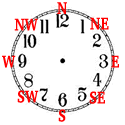
Eight Gates and Five Directions
When the center of your chest and navel face the 12 o'clock position,
your right side faces 3 o'clock,
your back side faces 6
o'clock,
and your left side faces 9 o'clock.
| Directional
Instructions Used in describing the Chen Style of Taijiquan, Old Frame, First Form, Laojia Yilu
|
|||
| Key | Clock Hour Direction |
Compass Direction A |
|
| N12 | 12:00 o'clock | North - Front Side of Body | |
| NE1 | 1:30 o'clock | Northeast | |
| E3 | 3:00 o'clock | East - Right Side of Body | |
| SE4 | 4:30 o'clock | Southeast | |
| S6 | 6:00 o'clock | South - Back Side of Body | |
| SW7 | 7:30 o'clock | Southwest | |
| W9 | 9:00 o'clock | West - Left Side of Body | |
| NW10 | 10:30 o'clock | Northwest | |
My Quick Highlight Notes and Directional Keys for my initial Practicing of the Chen Taijiquan First Form, Section 1, Movements 1-10
Movement 1 Taiji Preparation and Opening Taiji Qi Shi
Opening Meditation, Standing Still, Mental Preparation
Face N12, Feet together, hands at hips, head lifted, shoulders down, alert, ready, relaxed.
Step left foot to W9 to shoulder width, heel first, both arms lifted to shoulder
height with hands down,
bend
knees as hands lower to mid-waist, look to N12.
Movement 2 Pounding the Mortar Jin Gang Dao Dui
Flourish hands to right at little, then both hands move to W9, then rotate hands clockwise at chest height to
right until R hand points to SE4,
observe hand rotation (flourish, spiraling, twisting) and turning details, step
left leg to NW11 heel first, both hands rotate clockwise, face N12, step forward with R leg and toe to N12, feet together, L hand on right forearm, bring R
hand on top of L palm at waist, step to R leg to stamp ground as R fist slaps L
palm. End facing N12. Shift weight and bend knees when moving from R
to L sides. Look to N12.
"If one is persistent and practices every day, proficiency in the form will be achievable within half a year." - Davidine Siaw-Voon Sim
“There are no absolute rules for learning
Chinese Internal martial arts. The arts are difficult to assimilate, and you
need time to build up skill slowly. Like other activities, such as painting,
calligraphy, the techniques grow year by year with your passion and interest.
There are no short cuts to attain skills in Chinese internal martial arts. Art
is life, life has to be lived and experienced. Even if you learn and try to
emulate very closely, the kung fu (skill developed with time), or all of the
accumulated in-depth knowledge in books or from teachers, these skills cannot be
grasped quickly. There are no easy ways to judge the accomplishments of someone
other than yourself so focus on your personal development. There are
no short cuts to attain skills in Chinese internal martial arts. Art is life,
life has to be lived and experienced. Even if you learn and try to emulate very
closely, the kung fu (skill developed with time), or all of the accumulated
in-depth knowledge in books or from teachers, these skills cannot be grasped
quickly. There are no easy ways to judge the accomplishments of someone other
than yourself so focus on your personal development. You are becoming an
artist. The lifelong aim of an artist is to establish his own style. In order to
achieve this, the artist must explore. He must have passion, belief,
industriousness, intelligence, inwardness, spirituality, high moral conduct, and
intuitive ability to know right or wrong methods. Be wary of anyone who self-
proclaims himself a master. You must eventually find your own path, the mere
ability to imitate methods from books or teachers is a dead skill."
- Qi Bai Shi (齊白石) (1864–1957) Finding Your Art In Zhōngguó wúshù
Learning the Old Frame, First Form, Lao Jia Yi Lu of Chen Taijiquan in 2021-2022
Notes, Journal, Suggestions, Comments, Research, Progress Reports, Studies, Plans
I have four choices for my Taijiquan and Qigong practice areas
at our home:
First, in my living room,
after moving a chair, on a wood floor, the Taijiquan Form workout space is is
approximately 20 feet long and 5-6 feet wide. Second, at the front door to
the back sliding glass door, on a linoleum tile floor, the Taijiquan Form
workout space is approximately 20 feet long and 4-6 feet wide.
Third, on my back porch, outdoors and uncovered, with a concrete floor, I have a
workout space of approximately 17 feet by 12 feet wide. Fourth, in my back yard, under the deep shade of massive Douglas Fir trees, on
dirt, I have plenty of space for practicing Taijiquan.
Section 1, Movements 1 - 10 List of Movements, PDF format
Movement 3 Lazily Tying One's Coat Lan Zha Yi
Begin facing N12, shift weight to L, both arms come up to cross on R side, R
hand up, L hand down, rotate outward L up palm out, almost to Wild Stork Cools
Wing, bring R back as R leg draws up and in to center, as you step to R into
wide lunge, bring both hands together R under left, shift weight to W3, R hand
turns from down to facing outward and moves to right side and arm extended, R
palm up and out, shift weight R70L30, end with L hand on waist and R arm
extended, settle, look towards NE1.5 at R hand. Shift R, shift L, shift R,
Step R, shift R, settle into NE1.5. Complicated hand movements to
memorize.
Movement 4 Six Sealing Four Closing Liu Feng Si Bi
Movement 5. Single Whip, Dan Bian
I studied the many photographs for each movement in the fine book by
"1. Develop your ability to
maintain your vertical centerline as an axis from the Bai Hui
downwards through the perineum.
2. Develop your ability to always move fluidly from your center.
3. Maintain your root so that you do not bounce up.
4. Allow your spirit and intention to manifest within each movement.
5. Develop your Ting Jing skill in order to listen and perceive what
needs to be perceived.
6. Always strive to integrate the different parts of your body,
as well as the different parts of your self.
7. Always attend to stregthening the weakest part.
8. Breath naturally.
9. Like water, seek the most natural path. Employ the least amount of
force necessary for any given action.
10. When issuing force forward, root down to the back and draw in the
front. When receiving for from the front, root to the front and ground
down to the back.
11. Remember that both life and T'ai Chi are temporary gifts.
Celebrate them accordingly."
- John Loupos, Inside Tai Chi, p. 181
Journal of Michael P. Garofalo - Case Study - Learning the Chen First Form - Weekly Notes
Chen Taijiquan Laojia Yilu Taijiquan Classics Chen Taijiquan Quotations
How to Live a Good Life: Advice From Wise Persons Meetings with Chang San-Feng Pulling Onions
A good teacher is essential to your progress in Chen Style of
Taijiquan. Therefore, being that I am
determined to learn Chen Style Taijiquan. I can make steady
progress in studying and learning more about the Chen Style Taijiquan by using
instructional DVDs and books. When opportunities and finances permit, I look forward to direct
instruction from a qualified teacher.
I will be attending the online Introductory Chen Taijiquan workshop led by Scoot House (Scooter) from the Seattle Embrace the Moon School in October and November of 2022.
I also use the online resources provided by Ken Gullette.
There are options for using a few qualified Chen Taijiquan teachers in Portland, however driving from Vancouver to Taijiquan classes in Portland is very time consuming due to heavy traffic. Also there are rising gas costs, parking costs, and class instruction costs. The class schedules are sometimes not convenient for me, especially related to driving at night in heavy traffic. There are no satisfactory, for me, instructors in Vancouver.

Biography of Michael P. Garofalo
© Michael P. Garofalo, Green Way Research, 2013-2023
This webpage was last edited,
changed, corrected, modified
or updated on October 28, 2022.
This webpage was first
published on the Internet on October 1, 2013.
Cloud Hands: T'ai Chi Ch'uan Website
Chen Style Taijiquan and Qigong
Valley Spirit Center, Red Bluff, California
Detailed Index to the Cloud Hands Website

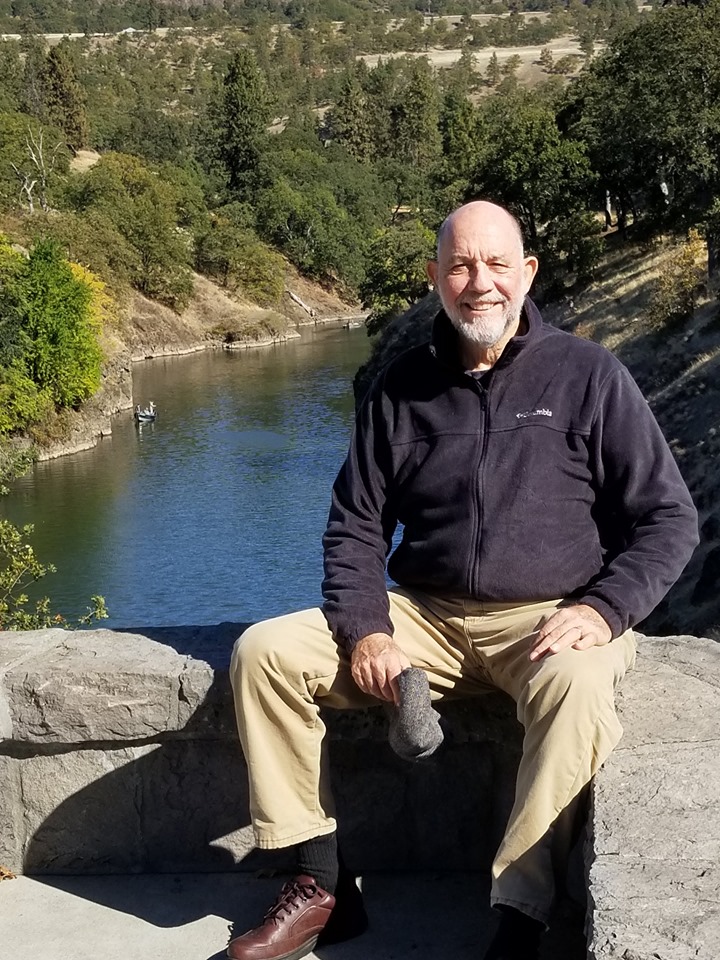
Mike Garofalo at the Klickitat River, WA, in November 2019
Cloud Hands Blog of
Michael P. Garofalo

Facebook of
Michael P. Garofalo

Return to
the Alphabetical Index of Mike Garofalo's Hypertext Documents